
Contents
- Vocabulary
- Who does what: contract manufacturer, design partner or sourcing agent?
- How long does choosing a factory take?
- Where should you build: China, Vietnam, Mexico, Europe or the US?
- Why do factories ignore small orders?
- Where do you find contract manufacturers?
- What goes in an RFQ package?
- How do you compare quotes?
- How do you vet a contract manufacturer?
- What should the contract say?
- Checklist: choosing your contract manufacturer
- FAQ
- Who we are
- Sources
In short
- With a working prototype of your own design, you hire a contract manufacturer (CM), plus engineering help if DFM (design for manufacturing) is not done.
- Choose the factory during DFM and sign by design freeze (week 7 on our road map). For audits and a second quote round, start the long list before you freeze the prototype.
- Compare what each quote costs once the goods reach your warehouse: molds, set-up, testing, freight and duty, not just the unit price. In our example the factory with the lowest unit price ends up USD 7,000 more expensive than the cheapest one. And cheapest is not always best: we would pay USD 2,600 more for a factory a short truck ride from our EU customers.
- Audit the winner (from about USD 280 to 400 per auditor day) and sign the manufacturing agreement before the tooling deposit.
To choose a contract manufacturer, first decide whether your design is ready to build or still needs engineering help. Then send one complete quote package to 3 to 5 factories that build products like yours at your volume. Compare total landed cost, not unit price. Score each on capability, quality, communication and cost, audit the winner, and sign before paying.
This post is for a team with a working prototype, a first run of 300 to 1,000 units ahead, and nobody who has picked a factory before. Our example is the product from our 31-week road map: a simple Bluetooth gadget with a molded case, sold in the US and EU.
1Vocabulary
| Term | What it means |
|---|---|
| CM (contract manufacturer) | A factory that builds your design from your files. It does not own the design. |
| EMS (electronics manufacturing services) | A CM for electronics: boards, cables, final assembly and test. |
| JDM (joint design manufacturer) | You and the factory design the product together. |
| NPI (new product introduction) | Moving a design into production: DFM, builds, test, line set-up. |
| DFM (design for manufacturing) | Reworking parts so a factory can make them fast, cheap and the same every time. |
| Box build | Final assembly: boards, case, battery, test, packing. |
| Turnkey, consigned | Two ways to buy the parts. Turnkey: the CM buys them. Consigned: you buy them and send them to the CM. Section 2 compares them. |
| RFQ (request for quote) | The package you send factories so they can price your product. |
| BOM (bill of materials) | The full parts list: every component, its maker, quantity and price. |
| NRE (non-recurring engineering) | One-time costs: set-up, stencils, programming, fixtures. |
| MOQ (minimum order quantity) | The smallest order a factory or part supplier accepts. |
| NNN agreement | Non-disclosure, non-use, non-circumvention: no sharing, copying or going around you. |
| EVT (engineering validation test) | A small build with production-intent boards in printed or cast cases. |
| DVT (design validation test) | Units made from the production molds. They go through reliability tests and to the certification lab. |
| T1, T2 | The first and second sample parts from a new mold. |
| Pilot run | A small batch on the real line with the real molds, after T1/T2. |
| Golden sample | The signed reference unit every production unit is checked against. |
| AQL (acceptance quality limit) | The sampling rule an inspector uses to pass or fail a lot. |
| FOB, DDP | FOB: the price ends when goods are loaded on the ship; freight and duty are yours. DDP: the seller delivers to your door, duty paid. |
| ISO 9001 | The basic quality management standard. |
2Who does what: contract manufacturer, design partner or sourcing agent?
It depends on how finished your design is. A contract manufacturer builds your design. A product development firm finishes the engineering first. A joint design manufacturer designs it with you. A sourcing agent finds factories but builds nothing.
| Who | What they do | Who owns the design | Fits when | Main risk |
|---|---|---|---|---|
| Contract manufacturer (CM) or electronics manufacturing services (EMS) | Builds your product from your files | You, if the contract also gives you the factory's changes | Your design is ready for production | Builds what you sent, flaws included |
| New product introduction (NPI) or product development firm | DFM, builds, hand-over to a CM | You, if the contract assigns their work to you | The prototype works, production engineering is not done | Cost; depends on the people |
| Joint design manufacturer (JDM) | Designs with you, then builds | Shared, by contract | You have the idea, not the engineering | Vague IP split |
| Sourcing agent | Finds factories, negotiates, arranges inspection | You, if the contract says so | Simple products close to existing ones | Hidden commissions |
| Online platform (Xometry, Fictiv, Protolabs) | Instant prices for parts | You | Prototype and bridge parts | Built for parts; whole-product box build is not their core |
Agents usually charge 3 to 10 percent of the order value, or a fixed fee (Cosmo Sourcing). Platforms add their own margin: Xometry kept about a third of its marketplace revenue as gross profit in 2025 (Xometry).
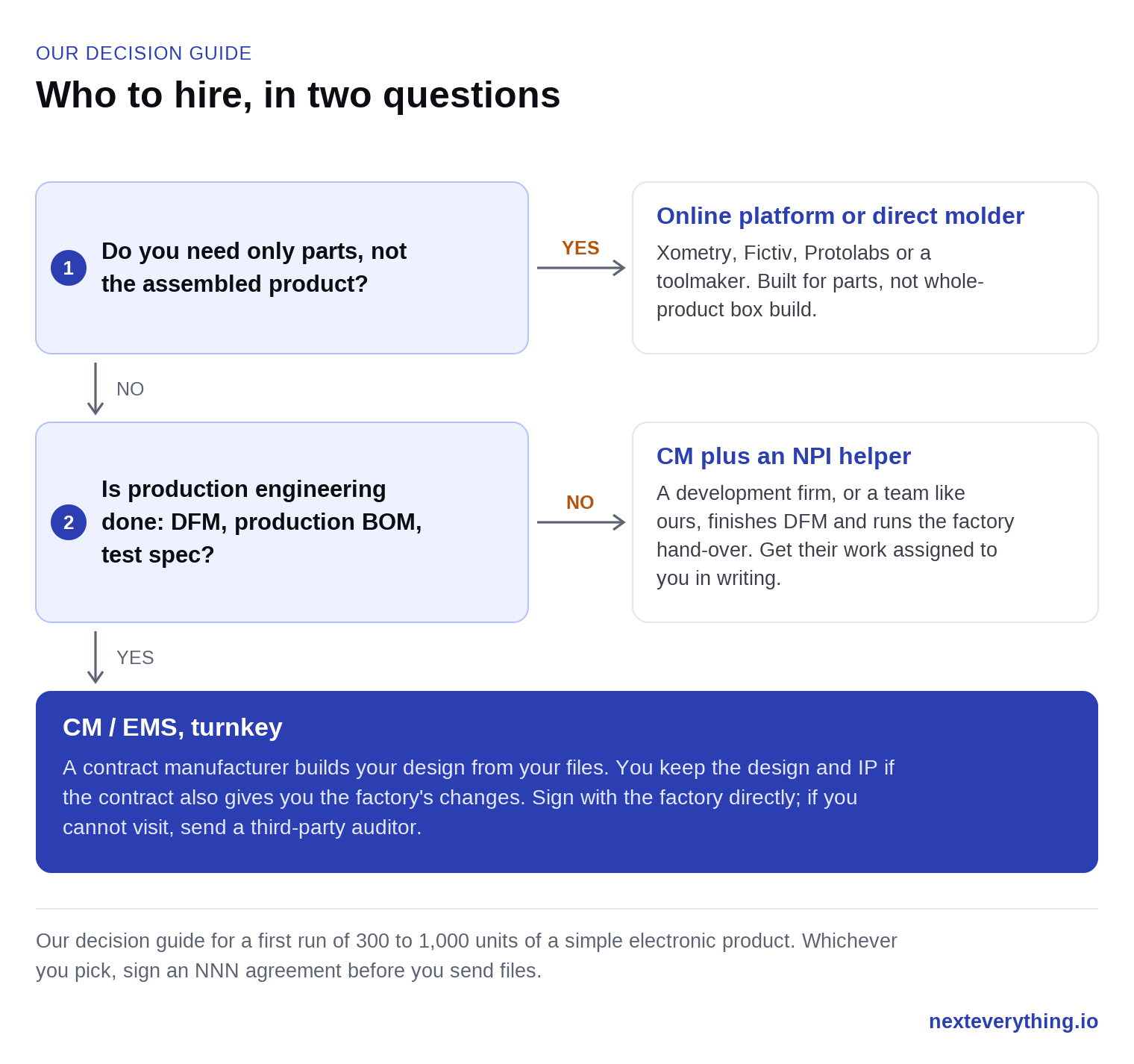
The IP point decides most cases. If you built your own prototype, keep it yours: hire a CM, add an NPI firm if DFM, the production parts list and the test spec are not done yet, and get the work they add assigned to you in writing.
Turnkey or consigned? These are the two ways to buy the parts for your product.
- Turnkey: the CM buys every part on your BOM and sells you the finished product. One price, and one party responsible when a part is late or wrong.
- Consigned: you buy the parts yourself and ship them to the CM, which charges only for assembly and test. Cheaper on paper, but every missing or wrong part is your problem, and the line waits while you fix it.
For a first run we suggest turnkey with an open parts list: the CM shows the price of each BOM line, so you can see its markup, and the agreement makes late parts the CM's problem.
3How long does choosing a factory take?
Your factory choice happens during DFM and is signed by design freeze, week 7 on our road map. That is when the tooling deposit is paid, so the agreement has to be in place by then.
Week 0 is feature freeze on our road map, the point where you stop adding features to the prototype.
| Step | Best case, road map week | With audits and a second quote round (our estimate) |
|---|---|---|
| Long list, shortlist, NNN signed | Weeks 0 to 3, during DFM | Start 3 weeks before week 0, while the prototype is still in testing; done by week 2 |
| RFQ out, quotes back, questions answered | Weeks 3 to 5 | Weeks 2 to 5 |
| Audit and a paid EVT build by the top candidate | Weeks 5 to 7 | Weeks 5 to 7 |
| Agreement signed, tooling deposit paid | Week 7 | Week 7 |
| Pilot run on the real line | Weeks 21 to 22, after T1/T2 and DVT | Weeks 21 to 22 |
The work takes 6 to 10 weeks, by our estimate. If you want audits and a second quote round, start the long list before you freeze the prototype. The risk the plan prevents: a choice that slips past design freeze starts the molds late and moves every later date. Mold timing is in our injection molding guide.
4Where should you build: China, Vietnam, Mexico, Europe or the US?
Decide this before you shortlist. Three things decide it: where your customers are, the import duty into that market, and how far you are from the factory when something goes wrong. For a first run of a simple electronic gadget, China is still the default. The others win on duty or distance.
| Option | Strong at | Weak at | Shipping time (our estimate) |
|---|---|---|---|
| China | Every part, toolmaker and small-batch board house within a few hours; the cheapest tooling; most factories that take small runs | Far away; contracts are harder to enforce; extra US duties | 3 to 5 weeks door to door to the US, 6 to 8 to the EU by sea |
| Vietnam | Fast-growing electronics assembly, without the China-only US duties | Many parts and molds still come from China, so lead times and part costs are similar or higher; fewer factories take tiny runs | Similar to China |
| Mexico | Trucked into the US in days; low or no US duty | Costs more than China at small volumes; fewer factories that work with startups; parts often come from Asia | Days to the US by truck |
| Europe, for example Poland | Next door to EU customers, no import step, cheap visits; labor in Poland costs about half the EU average | Higher unit cost than Asia; molds are often still made in China | Days within the EU by truck |
| United States | No import duty into the US on the finished product; the fastest fixes and visits | The highest labor cost; few factories take 500-unit runs at a sensible price; imported parts still pay duty | Days |
Manufacturing labor cost EUR 17.1 an hour in Poland in 2025, against an EU average of EUR 35.0 (Eurostat).
What the US duties mean. Since 24 July 2026 the US charges an extra import duty, on top of the normal one, on goods from many countries (91 FR 47318). This is the rate for your product's category as of November 2026:
| Built in | Extra US import duty |
|---|---|
| China | 12.5 percent, on top of the older China-only duties, which remain in effect |
| Vietnam | 12.5 percent, with no older China-only duties |
| Mexico | 10 percent; none for goods that enter duty-free under the USMCA trade agreement |
| EU | 10 percent in total, the normal duty included; nothing extra if the normal duty is already 10 percent or more |
| United States | None on the finished product |
So the same product usually pays more into the US from China than from Vietnam. How much more depends on which older list your customs code is on, and some codes are excluded. Ask a customs broker for your code before you set a price.
Our rule of thumb for a first run:
- Selling mostly in the US: compare China and Vietnam on landed cost with the duty for your customs code. Look at Mexico if you need fast restocks and your product qualifies under the USMCA.
- Selling mostly in the EU: a European factory costs more per unit but saves weeks of freight and makes every visit cheap. China wins only if the price gap is large.
- Selling in both: one factory in Asia shipping to both markets is still the simplest first run.
- Anywhere: molds made in China are common even when assembly happens elsewhere.
5Why do factories ignore small orders?
Because a run of 500 needs the same set-up work as a run of 50,000, and pays far less. In 2015 Rui Ma described in TechCrunch how reputable Chinese factories prefer steady repeat customers and check a startup's finances before they say yes (TechCrunch). Sofeast warned back in 2012 that big factories push small orders behind larger ones, subcontract them or hand them to a junior salesperson (Sofeast). One US product development firm says today that most CMs want "1,000+ units per year to prioritise an account" (LA NPDT).
Small runs also pay more for parts, because they fall below the MOQ of reels and custom components.
How to make your order worth quoting
- Pick the right size. Bunnie Huang's 2013 rule: the biggest factory where you still get regular access to the boss (Bunnie Huang).
- Send a complete package. Section 7 has the list.
- Give a real forecast. First order and the honest next step, for example 1,000 now and 3,000 next year if the campaign sells. Ask for prices at 500, 2,000 and 5,000.
- Show how the run is funded.
- Be easy to work with. One named contact, answers within a day, decisions in writing.
- Use standard parts and stock colors. Ask which parts the CM already stocks.
6Where do you find contract manufacturers?
| Channel | Good for | Watch out for |
|---|---|---|
| Referrals from founders, designers, investors | The fastest trust | One name is not a shortlist |
| EveryJobShop, our own directory: 8,718 manufacturers in 29 countries as of 15 October 2026 | Search by country, process and certification | A listing is not proof of capability |
| Kickstarter Partner Program, launched February 2026 | Crowdfunded hardware | Vet every partner yourself |
| Trade shows (Global Sources in Hong Kong, the Canton Fair) and marketplaces (Alibaba, Made-in-China) | Many factories at once | Many are trading companies, not factories |
| Ask us: tell us your product and volume, and we find and vet the factories for you | Teams without the time or the contacts | It is a paid service; the first 30-minute call is free |
Cut the long list to 3 to 5 with three checks:
- Similar products built at 500 to 5,000 units, and a reference customer in your category.
- The right processes in-house. For our gadget: board assembly, final assembly and test, plus a named molding partner.
- A real factory. A business license that matches the name on the quote, and a live video walk of the floor.
Sign the NNN agreement with the shortlist before you send CAD files.
7What goes in an RFQ package?
Everything a factory needs to price your product without guessing, sent in two steps so your design stays protected.
Step 1, to the long list, before any NNN: enough to say yes or no and give a rough price, without the design itself.
- What the product is and does, with outside photos or renders (no internals)
- Size, weight, materials and finish, and the processes it needs: board assembly, molding, final assembly
- Volumes and target dates
- A summary BOM: part types and counts, not your exact parts and makers
Step 2, to the shortlist, after the NNN is signed: the full package.
- STEP files for every part and the assembly
- 2D drawings with critical dimensions, tolerances, material and finish
- The full BOM (bill of materials), with approved makers and an alternate for each key part
- Board files: Gerbers or ODB++, drill, pick-and-place, assembly drawing
- The test spec, ideally with the fixture design
- Packaging spec and artwork
- Volumes: first order, forecast, price breaks at 500, 2,000 and 5,000
- Delivery term (FOB, or delivered to your warehouse), target dates, who handles certification
- Your quote template, with one-time costs split from the unit price
Send the same full package on the same day to every factory on the shortlist.
8How do you compare quotes?
Line by line, then landed in your warehouse. Unit price alone tells you little.
Here is one run of 1,000 units of our gadget, quoted by three factories, for a seller whose stock goes to an EU warehouse. A and B quote FOB Shenzhen, C quotes delivered.
| Factory A, Shenzhen EMS | Factory B, Dongguan | Factory C, Poland EMS | |
|---|---|---|---|
| Unit price | USD 22.00 | USD 18.50 | USD 27.00 |
| Molds, 4 tools | USD 16,000 | USD 21,000 | USD 17,000 |
| NRE | USD 2,500 | USD 4,500 | USD 2,000 |
| Test fixture | USD 2,000 | USD 3,000 (not quoted, we add it) | USD 2,500 |
| Test and packing per unit | USD 1.10 | USD 3.60 | USD 0.90 |
| Factory total | USD 43,600 | USD 50,600 | USD 49,400 |
| Freight and EU duty | about USD 3,200 | about USD 3,200 | Included |
| Landed in the EU | USD 46,800 | USD 53,800 | USD 49,400 |
Illustrative quotes, our estimate, including the payment and mold-trial terms. Freight and duty assume USD 2,500 for sea freight and clearance plus 3 percent duty on the goods; duty on the molds would add a few hundred dollars and not change the order. C's molds are made in China through its partner toolmaker.
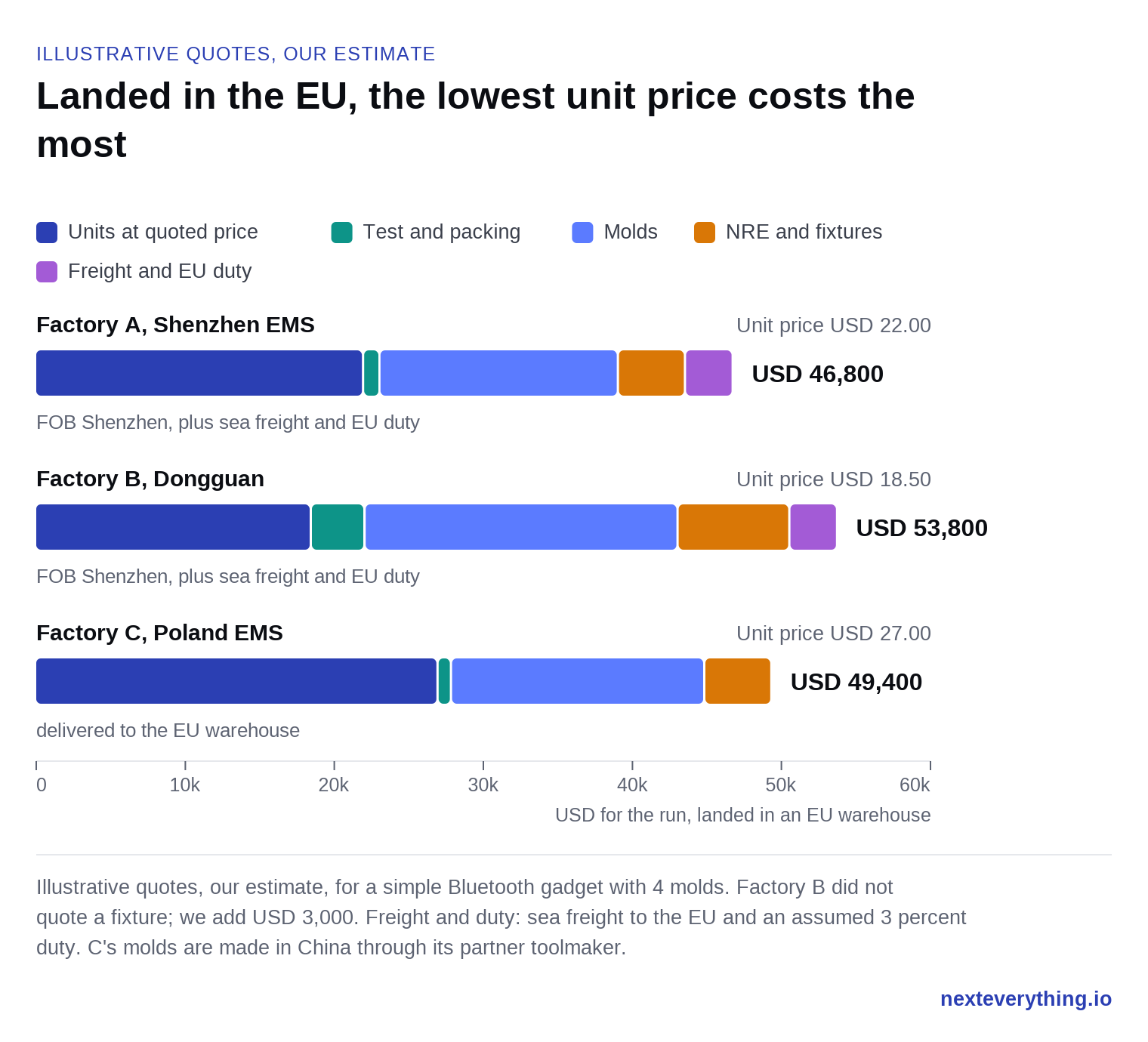
Factory B looks cheapest and is not: its molds and NRE cost more, the fixture is missing, and test and packing are extra. A is the cheapest landed. C costs USD 2,600 more than A but arrives by truck within days of packing, while A's goods spend weeks at sea. A and C include two mold trials, and A takes 70 percent after inspection; B includes one trial and wants 50 percent before inspection.
On every quote, check:
- Parts prices. A 500-unit quote priced on 5,000-unit parts gets re-quoted later.
- Molds. Trial rounds included, who pays for changes, who owns them.
- Test. Every unit or a sample, and what is tested.
- Payment. A balance paid after your inspection is worth more than a lower price.
9How do you vet a contract manufacturer?
With a scorecard, a certificate check, an audit and a paid sample build.
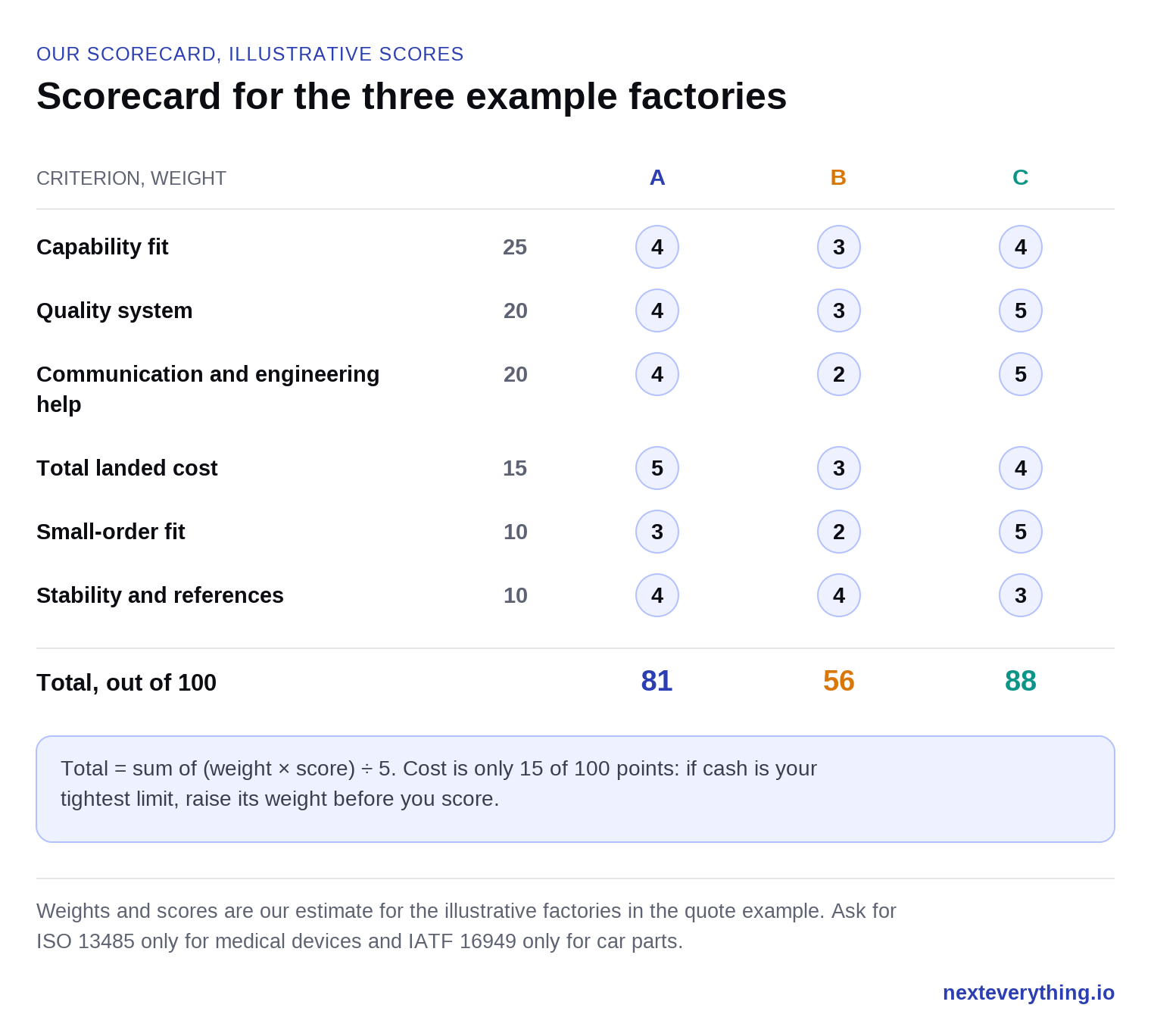
C scores top marks on communication because it is a short trip away for samples and fixes, and it delivers to your warehouse. Our verdict for EU customers: audit C first, keep A as the fallback. The USD 2,600 extra buys faster fixes and a shorter supply line, which protects the ship date. For US customers, A or a Vietnam CM, after the tariff check in section 4. If cash is your tightest limit, raise the cost weight before you score.
Certificates. ISO 9001 is the baseline. Ask for ISO 13485 only for a medical device and IATF 16949 only for car parts. ISO itself certifies nobody. Check the certificate in IAF CertSearch, the database ISO points to, which lists only accredited certificates (ISO). No record means: ask the certification body.
Audit. A third-party audit checks that the factory is real, owns its lines and runs a quality system. V-Trust lists USD 398 per auditor day in Asia, travel included (V-Trust); QCadvisor starts at USD 280 (QCadvisor). A small factory takes one or two auditor days, by our estimate, so USD 300 to 800. Have the auditor look at the line that will build your product, not the showroom.
Sample build. Before you sign, pay the top candidate to build your EVT units: production-intent boards, assembled and tested, in printed or cast cases. It shows how they work before any steel is cut. The pilot on the real line comes later, after T1/T2, as a payment milestone in the agreement.
Red flags
Harris Sliwoski, a law firm working on China manufacturing, lists warning signs for agents and middlemen. In short:
- Identity: license and invoice in different company names, stock photos, no direct contact with the factory
- Money: payment to personal or offshore accounts, no cost breakdown
- Access: no unscheduled visits
In one case they describe, an agent claiming a 5 percent commission inflated prices by 35 percent and took another 10 to 15 percent from the factories. If you use an agent, sign with the factory directly.
Two more, our own view: a quote with no questions about your files, and a factory that will not sign your NNN agreement.
10What should the contract say?
Put the terms in writing after you choose the factory and before you pay a substantial deposit or for tooling.
| Document | When | What it covers |
|---|---|---|
| NNN agreement | Before CAD files go out | No sharing, copying or going around you, also through the factory's related companies and subcontractors |
| Development agreement | If the factory still engineers part of the product | Who owns the results, what "accepted" means |
| Manufacturing agreement | Before tooling and deposits | Price, quantities, dates, quality, inspection, payment, IP, subcontracting, disputes |
| Tooling terms | Before the molds are made; standalone or a section of the agreement | You own the molds and the design in them; marked, kept at the named factory, used only for you, released on notice |
Points the manufacturing agreement should settle:
- Quality: measurable specs, the golden sample and an AQL level (post-01 has the numbers), never just "good quality"
- Inspection: your right to send an independent inspector
- Payment: Chinese suppliers usually ask 30 percent before production and 70 percent before shipping (Sofeast); tie the 70 percent to a passed inspection, and the pilot to a milestone
- IP: your designs used only to make your products, and changes the factory makes to them assigned to you in writing
- Tooling: ownership in writing; our molding guide has the details
- Subcontracting: only with your written approval
- Warranty: one year against defects is a possible starting point. If you sell to EU consumers, you owe them at least two years for defects present at delivery, so ask the factory to cover the same period
- Law and disputes: for a factory in mainland China, China lawyers often recommend Chinese law and dispute resolution in China, with the Chinese text in control, because that is where a ruling can be enforced
Outside China the topics are the same, the law and courts are not; have a local lawyer review the agreement.
11Checklist: choosing your contract manufacturer
In road map order:
- Partner type chosen; design yours, IP staying with you
- Build country chosen for your customers and tariffs
- Shortlist of 3 to 5; NNN signed before CAD files go out
- RFQ package complete, with forecast and price breaks
- Quotes on one template, compared landed in your warehouse
- Scorecard filled in; certificates checked in IAF CertSearch
- Third-party audit of the top candidate
- Paid EVT build by that candidate
- Manufacturing agreement and tooling terms signed by design freeze
- Tooling deposit paid; T1/T2 dates and trial rounds in writing
- Pilot run after T1/T2 and DVT, tied to a payment milestone
- Balance tied to a passed pre-shipment inspection
Our launch planner puts factory choice, certification and freight on one calendar. For certification, see FCC and CE certification for hardware startups.
FAQ
What is the difference between a contract manufacturer and a sourcing agent? A contract manufacturer builds your product in its own factory. A sourcing agent finds and manages factories for you but builds nothing, and is paid a commission or a fee.
How many units does a contract manufacturer need? Most prefer 1,000 or more a year, but board assembly can start at 25 to 100 boards.
Do I need a sourcing agent? Only for a simple product close to an existing one. If you use one, sign with the factory directly.
Should I visit the factory? Yes, or send a third-party auditor. An audit costs a few hundred dollars, a small share of the tooling deposit.
Who we are
Next Everything is three co-founders who help hardware teams get from a working prototype to a first small series. Stan Rajm owns the plan: dates, budget and decisions. Simon Tański runs engineering; he is ex-Bosch and built a food printer by hand. Filip Hanasz handles suppliers, quotes and factory visits. In a free 30-minute call we go through your shortlist and quotes and tell you what is missing.
This guide describes common practice for a first production run of a simple consumer electronics product, as of November 2026. Tariffs, prices and lead times change. The contract, IP and tariff points are general information, not legal or customs advice. Have your agreements reviewed by a lawyer who works with factories in your supplier's country, and your customs codes checked by a broker.
Sources
Choosing and working with factories
- LA NPDT, electronics contract manufacturing: models, costs, vetting: lanpdt.com
- Rui Ma, factories aren't dying to take your order (TechCrunch, 2015): techcrunch.com
- Bunnie Huang, picking and maintaining a partner (2013): bunniestudios.com
- Sofeast, the small buyer's dilemma in China (2012): qualityinspection.org, and payment terms: qualityinspection.org
- Cosmo Sourcing, what a sourcing company costs: cosmosourcing.com
- Xometry, full-year 2025 results: investors.xometry.com
- Kickstarter Partner Program: kickstarter.com
- EveryJobShop manufacturing directory: everyjobshop.com
Vetting and inspection
- ISO, how to verify an accredited certification: help.iso.org
- V-Trust, factory audit service and price: v-trust.com
- QCadvisor, pricing and costs: qcadvisor.com
Contracts
- Harris Sliwoski, NNN agreements: harris-sliwoski.com
- Harris Sliwoski, sourcing agent deceptions: harris-sliwoski.com
- Harris Sliwoski, NNN agreement vs manufacturing agreement: harris-sliwoski.com
- Harris Sliwoski, when one agreement is not enough: harris-sliwoski.com
- Harris Sliwoski, international manufacturing term sheet checklist: harris-sliwoski.com
Tariffs and costs by country
- USTR, Notice of Actions in Section 301 Investigations, 91 FR 47318 (28 July 2026): federalregister.gov
- Holland & Knight, new Section 301 tariffs on 60 economies (30 July 2026): hklaw.com
- KPMG, China Section 301 actions remain in effect (6 October 2026): kpmg.com
- Eurostat, labor cost levels by activity (lc_lci_lev), manufacturing, 2025: ec.europa.eu