
Contents
- Can I skip certification?
- Can I take pre-orders before certification?
- Vocabulary
- Which tests does my product need?
- Do I need certification if I use a pre-certified module?
- Do I need to pay for Bluetooth qualification?
- What does the US require?
- What does the EU require?
- What does the battery need for shipping?
- How much does certification cost?
- How long does certification take?
- How do you avoid failing?
- Pre-certification checklist
- FAQ
- Who we are
- Sources
In short
- A small Bluetooth gadget sold in the US and EU needs FCC authorization, CE marking under the EU Radio Equipment Directive (with its cybersecurity rules), UN38.3 papers for the battery, and EU producer registrations in each country you ship to.
- A pre-certified radio module covers the radio. The finished product is still tested, declared and labeled in both markets.
- You may take US pre-orders before you pass, with a set notice on the page. You may not ship a single unit until you pass.
- By our estimate, budget USD 20,000 to 40,000 for testing and the Bluetooth listing, plus about EUR 1,000 a year in service fees for each EU country you ship to, before recycling fees. Lab time is 5 weeks best case, 6 to 8 weeks realistic (our estimate).
- If your EU units ship after 18 February 2027, users must be able to swap the battery. Decide that before the molds are cut.
You have a working Bluetooth prototype and a launch date. Before the first unit reaches a buyer, it needs certification: tests and paperwork proving it meets FCC rules in the US and CE rules in the EU. On top come battery shipping papers and EU recycling registrations.
We use the same product as our road map from prototype to backers: a Bluetooth radio on a pre-certified module, a lithium-ion battery, made in China, sold in the US and EU. The UK, Canada and Australia have their own steps; this guide covers the US and EU only. Numbers with a link come from that source. Numbers we call our estimate are ours, built from the research behind this post.
1Can I skip certification?
No. Each market sets rules a product must meet before it reaches buyers: it must not jam other radios and it must be safe. In the EU the seller also pays toward recycling. Certification is how you prove it.
Forwarders refuse lithium batteries without test papers. In Germany, marketplaces and fulfillment warehouses are not allowed to handle electronics from producers who have not registered.
2Can I take pre-orders before certification?
In the US, yes, if your campaign page carries a set FCC notice. You may not ship a single unit to buyers, a fulfillment warehouse (including Amazon FBA) or a reseller until the product passes.
The notice must tell every buyer, at the time of the offer, three facts: the product is subject to FCC rules and delivery depends on passing them; FCC rules do not address whether consumer protection, contract or other federal or state law applies; and what you will do if it does not pass, including your refund policy. The rule is 47 CFR 2.803. Put it on the Kickstarter or Indiegogo page, your own shop and any pre-order email.
In the EU, the CE mark must be on the product before it is "placed on the market", the legal term for the first supply of a unit on the EU market, paid or free. EU guidance says a pre-order for a unit not yet made is not yet placing it on the market, but an online offer of finished stock to EU buyers is, and so are goods cleared through EU customs for sale. Ship no stock into the EU until the CE file is complete.
3Vocabulary
Building and testing
| Term | What it means |
|---|---|
| EVT, DVT | Engineering and design validation builds: your first production-intent boards, then the first units from production molds. |
| EMC | Electromagnetic compatibility: the product neither causes nor suffers from interference. |
| EMC pre-scan | A cheap trial run of the emissions test, before the real lab test. |
| Placing on the market | The EU legal term for the first supply of a unit on the EU market, paid or free. |
United States
| Term | What it means |
|---|---|
| FCC | Federal Communications Commission, the US regulator for anything that gives off radio energy. |
| Part 15B | FCC rules for digital circuits that leak radio noise ("unintentional radiators"). Almost every gadget with a processor falls here. |
| Part 15C | FCC rules for transmitters such as Bluetooth radios ("intentional radiators"). |
| SDoC | Supplier's Declaration of Conformity. You test the product and keep the records. Nothing is filed with the FCC. |
| FCC ID | The public ID a transmitter gets after a lab test and a review by a certification body. |
| Pre-certified module | A ready-made radio board with its own FCC ID and EU test reports, soldered into your product. |
European Union
| Term | What it means |
|---|---|
| CE marking | The mark that says a product meets the EU laws that apply to it. You affix it yourself after the checks. |
| RED | Radio Equipment Directive, the main EU law for anything with a radio. |
| EN 18031 | The European standard used to show a radio product meets RED's cybersecurity rules. |
| Notified body | An approved third-party assessor. Some EU routes need one. |
| DoC | Declaration of conformity, the signed statement that the product complies. |
| EU responsible person | A company based in the EU that answers to regulators for your product. |
| EPR, WEEE | Extended producer responsibility. In each EU country where you sell direct to consumers, you register and pay toward recycling of electronics (WEEE), batteries and packaging. |
| RoHS | The EU limit on hazardous substances in electronics. |
| GPSR | General Product Safety Regulation, the EU's catch-all safety law. |
| CRA | Cyber Resilience Act, the EU cybersecurity law that takes over from RED's cyber rules in December 2027. |
| UN38.3 | The UN test series a lithium battery must pass before it can be shipped. |
4Which tests does my product need?
It depends on whether the product has a radio, and whether that radio is a pre-certified module. A lithium battery adds its own set.
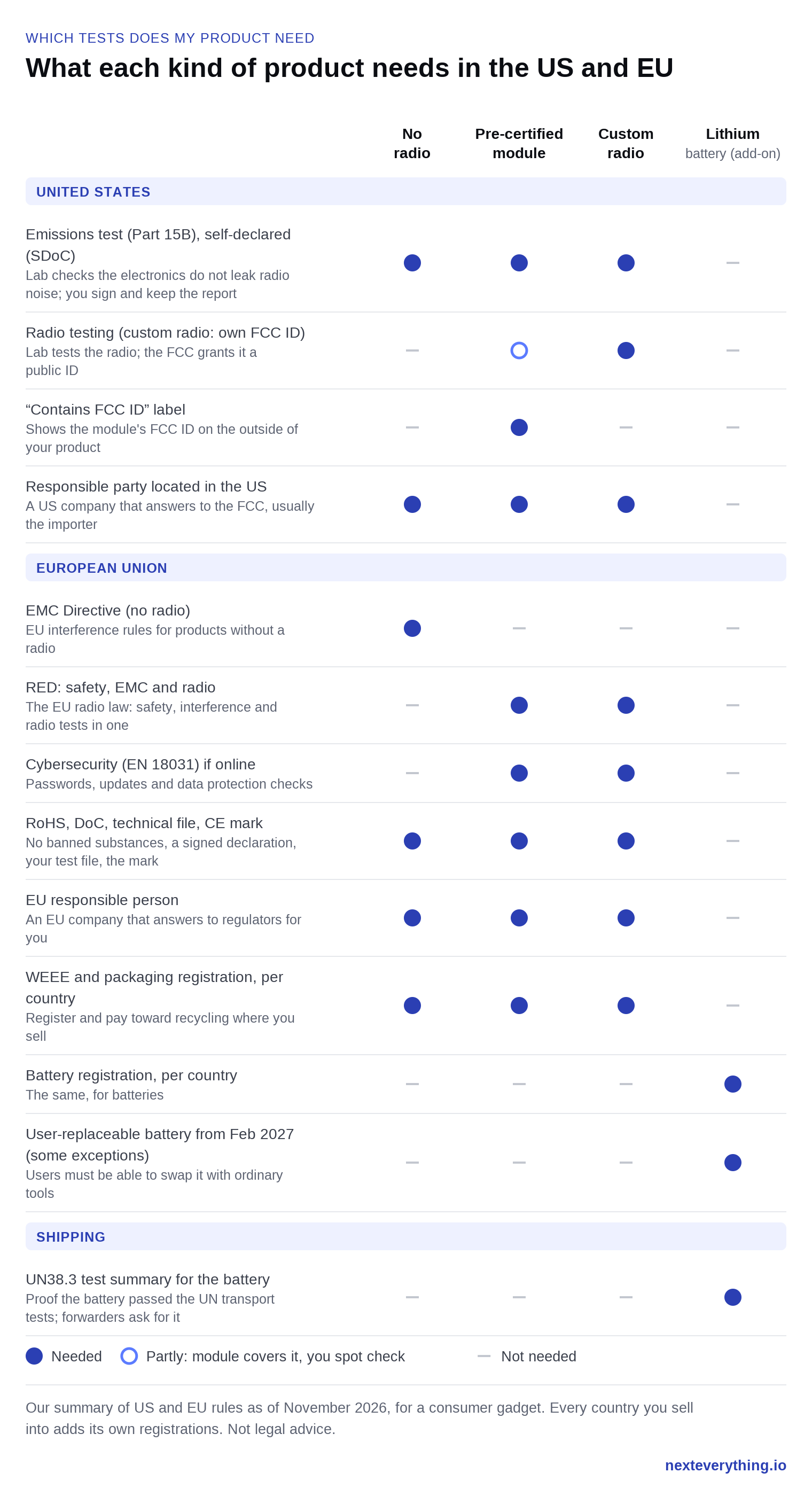
A product with no radio and a small battery is tested under the EU's EMC Directive instead of RED. The EU low-voltage law only starts at 75 V DC, so its safety rules come from the GPSR. In the US, a few slow battery-only devices skip Part 15B, but only if every clock runs below 1.705 MHz and the device cannot work while charging (47 CFR 15.103).
5Do I need certification if I use a pre-certified module?
Yes, but less of it. The module's grant covers the radio inside it, and only while you follow its conditions. Everything else about your product is still yours to test.
The FCC's guide for products that use modules (KDB 996369 D04) puts Part 15B testing and anything the module grant does not cover on the product maker. That means four jobs in the US:
- Follow the module's integration instructions. Use the approved antenna, keep the clearances, and keep the distance from the body the grant assumes. Break a condition and the module's FCC ID no longer covers you.
- Test your product for radio noise from its electronics (FCC Part 15B), usually by self-declaration (SDoC).
- Spot check the radio inside your product. Your case and board can create emissions the module test never saw.
- Label it. If the module's own label is hidden inside the case, the outside must say "Contains FCC ID:" followed by the module's ID (47 CFR 15.212).
If the module's conditions do not fit your design, you need a change filed by the module maker or your own FCC ID. Both cost weeks.
In the EU you sign the RED declaration for the whole product. The module maker's radio reports go into your file and can save radio testing. Safety, EMC and cybersecurity are still checked on your product, because they depend on your board, case, battery and firmware.
6Do I need to pay for Bluetooth qualification?
The Bluetooth name and logo are trademarks of the Bluetooth trade group (the Bluetooth SIG). You may only use them, on the product, the box, the listing or the website, after you join the group and qualify your product. That is the hard rule. "Bluetooth Low Energy compatible" still uses the name.
If you never use the name, no law forces you to qualify. But qualifying is also what gives you a free license to the patents that group members hold on the standard. Without it, you have no such license, so you carry patent risk. A qualified module from a member may cover part of that. It does not cover the whole product. We found no case of a small maker of an unbranded product being sued, but we cannot rule it out.
What it costs. At the free Adopter membership level the fee is up to USD 12,000 per new design as of March 2026. Paid memberships start at USD 3,500 a year. They cut the fee to USD 8,000 for your first product each year, or USD 6,000 for every product at the higher Associate level. Our cost table below includes the full fee.
Our advice: if you plan to sell widely, budget for qualification. For a small first run, plain wording such as "pairs with your phone" lowers the risk, but does not remove it.
7What does the US require?
The emissions test you self-declare (Part 15B, SDoC)
Almost every gadget with a processor leaks some radio noise, so the FCC wants it tested before you market it. Usually you self-declare: a lab tests the product, you keep the report, and nothing is filed with the FCC. This route is called SDoC. The product carries the Part 15 statement on its label, or in the manual and on the packaging if it is too small. The manual carries the standard Part 15 interference notice and a compliance statement with the product name and model and your US responsible party's name, address and phone or web contact.
The catch for a foreign startup: the party responsible for that self-declaration must be located in the US, and for imported goods that is the importer (47 CFR 2.1077). The usual options are a US company of your own, a US distributor or importer that buys your stock, or a US retailer that signs an agreement with the importer to take the role.
FCC rules also bar self-declaration testing at labs owned or controlled, even in part, by entities the FCC treats as prohibited, so ask your lab for a written ownership statement.
Your own FCC ID
A custom radio must be certified before marketing. You register with the FCC, buy a grantee code (your company's ID prefix, USD 35), test at a recognized lab, and file through a certification body (a private firm the FCC approves to grant IDs). The filing must name an agent in the US who can receive legal papers.
The 2028 lab rule
From 1 December 2028, new FCC ID applications must use tests from labs in the US or in places with a testing or trade deal with the US. Mainland China is not on the list. Hong Kong and Taiwan are (FCC 26-73, adopted 29 October 2026). FCC IDs granted before then stay valid. Self-declared emissions testing (Part 15B) is not changed for now, but the FCC is asking whether it should be, so a module-based product is not affected yet.
8What does the EU require?
The EU asks for more paperwork, in six parts.
RED: one law for safety, interference and radio
One EU law, RED, covers your gadget's safety, interference and radio use, even at 3.7 V. The lab usually tests to four standards:
| Area | Usual standard |
|---|---|
| Safety | EN 62368-1 |
| EMC | EN 301 489-1 and -17 |
| 2.4 GHz radio | EN 300 328 |
| Radio exposure | EN 62479 |
RED is not the only EU rule your electronics must meet. RoHS limits hazardous substances such as lead, mercury and cadmium in the board, parts and cables. Ask your factory for RoHS test reports or material declarations for the parts, keep them in your technical file, and list RoHS in your declaration of conformity.
Cybersecurity: EN 18031 now, the CRA from December 2027
Since 1 August 2025, the EU radio law also has cybersecurity rules.
- Does it apply to you? Yes if your product can reach the internet, directly or through other equipment such as a phone. A gadget that syncs through a phone app may count, depending on whether it or its app passes data on to the internet; ask your lab. Wearables, toys and childcare products that handle personal data are covered too.
- How you prove it. Most makers follow the European standard EN 18031. It checks things like passwords, secure updates and how stored data is protected.
- The password trap. If users can skip setting a password, the standard no longer counts as proof, and you need a notified body (a paid outside assessor). To keep the cheaper self-declaration route, force a password at setup or ship each device with its own unique one, and meet the rest of the standard. Toys and childcare products also need parental access control.
- What changes in December 2027. From 11 December 2027 the Cyber Resilience Act (CRA) replaces these rules for new products. You must provide security updates for at least five years, or for the product's expected use time if that is shorter.
- What already applies. Since 11 September 2026, makers must report security flaws that attackers are actively exploiting to EU cyber agencies, even for products already on sale.
The practical takeaway: build over-the-air updates in from the start.
Declaration of conformity and technical file
You write the technical file: description, schematics, standards applied, design calculations and examination results, test reports and the DoC. Keep it for 10 years. Each unit ships with the DoC or a short version pointing to it online. The manual must state the frequency band and maximum radio power, in the language each country requires. The CE mark goes on the product and the packaging.
The EU responsible person
A RED product can only be sold if a company based in the EU answers for it: an importer, an authorized representative you appoint in writing, or, if neither exists, the EU fulfillment company that handles your stock. Its name and address go on the product or packaging and on your shop and campaign pages. One appointment covers the whole EU.
Producer registrations, country by country
This is separate from CE. In each country where you sell directly to consumers, you register as a producer of electronics (WEEE), batteries and packaging, usually through a local representative. For batteries, EU law requires that representative in every country for direct sellers; for packaging, EU law requires it for direct sellers, with some rules left to member states; for electronics, national law decides, and Germany requires one.
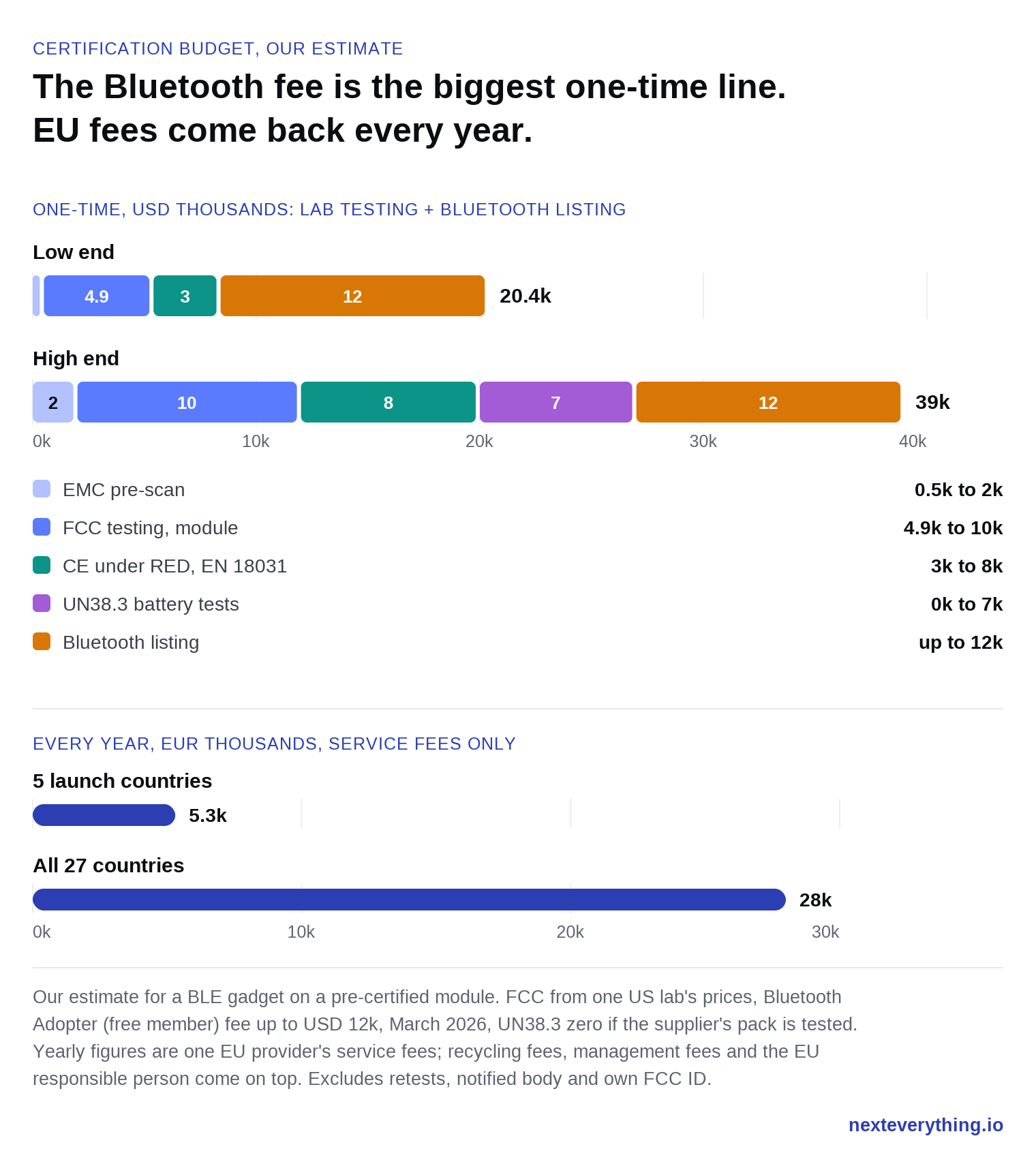
Germany's battery registration counts as granted at the latest 12 weeks after a complete filing under German battery law, so file at design freeze. One EU provider lists EUR 1,190 a year for all three registrations in the first country and EUR 1,030 for each extra one: about EUR 5,300 for 5 countries and EUR 28,000 for all 27. Those are service fees only; recycling fees, per-country management fees and set-up costs come on top.
User-replaceable batteries from February 2027
From 18 February 2027, a product sold in the EU with a portable battery must let the user remove and replace it with ordinary tools, without heat or solvents. Narrow exceptions exist, for example washable devices and small or sealed wearables (Delegated Regulation (EU) 2026/1770), and they only apply where safety requires it. Even then, an independent repairer must still be able to replace the battery. On our road map, units from a design frozen now ship after that date. A glued pouch cell is a design-freeze decision; see our guide to injection molding for startups for why changing the case later is expensive.
9What does the battery need for shipping?
Under US transport rules and the international air rules, every lithium battery type must pass UN38.3 before it ships (IATA guidance). The battery maker runs the tests and must give you a test summary. Forwarders ask for it before they book your freight.
Check it names your exact pack. A new pack needs its own tests: one battery pack maker puts that at USD 5,000 to 7,000 and 4 to 6 weeks (Epec). Untested prototypes and runs of 100 or fewer batteries a year follow a lighter route, but by air only on cargo planes and with approval from the authorities.
10How much does certification cost?
For our example gadget, by our estimate, about USD 20,000 to 40,000 one-time, plus yearly EU registration fees for each country you ship to. It breaks down into three lines.
| Line | Cost | Basis |
|---|---|---|
| Lab testing, US and EU | USD 8,400 to 27,000, one-time | Detail below |
| Bluetooth listing | Up to USD 12,000, one-time | Adopter (free member) fee, March 2026; the total assumes the full fee |
| One-time total | About USD 20,000 to 40,000 | Sum of the two lines |
| EU producer registrations | Service fees only: about EUR 5,300 a year for 5 countries, EUR 28,000 for all 27 | One provider's list price; recycling and management fees on top |
| EU responsible person | EUR 300 to 2,000 a year | Our estimate |
The lab testing line, in detail:
| Item | Cost (USD) | Basis |
|---|---|---|
| EMC pre-scan on EVT boards | 500 to 2,000 | Our estimate |
| FCC testing and filing with a pre-certified module | 4,900 to 10,000 | One US lab's published prices; a pure SDoC route is listed lower (Compliance Testing) |
| CE under RED, EN 18031 self-declared | 3,000 to 8,000 or more | Our estimate; EU labs rarely publish prices, so get two quotes |
| UN38.3 | 0 to 7,000 | 0 if the supplier's pack is tested; new pack per Epec |
Not included: a failed test and retest, a notified body, your own FCC ID (one lab lists USD 7,900 to 12,000 plus the grant fee), translations and US importer fees.
11How long does certification take?
Lab testing takes 5 weeks best case and 6 to 8 weeks realistic, by our estimate, for FCC, CE and EN 18031 together in one lab window.
| Step | Time |
|---|---|
| Lab testing (FCC, CE, EN 18031) | 5 weeks best case, 6 to 8 realistic (our estimate) |
| UN38.3 for a new pack | 4 to 6 weeks (Epec) |
| German battery registration | Up to 12 weeks |
| One failed test | Adds 4 to 12 weeks (our estimate) |
On our road map, units from production molds reach the lab in week 17 and freight leaves in week 25.
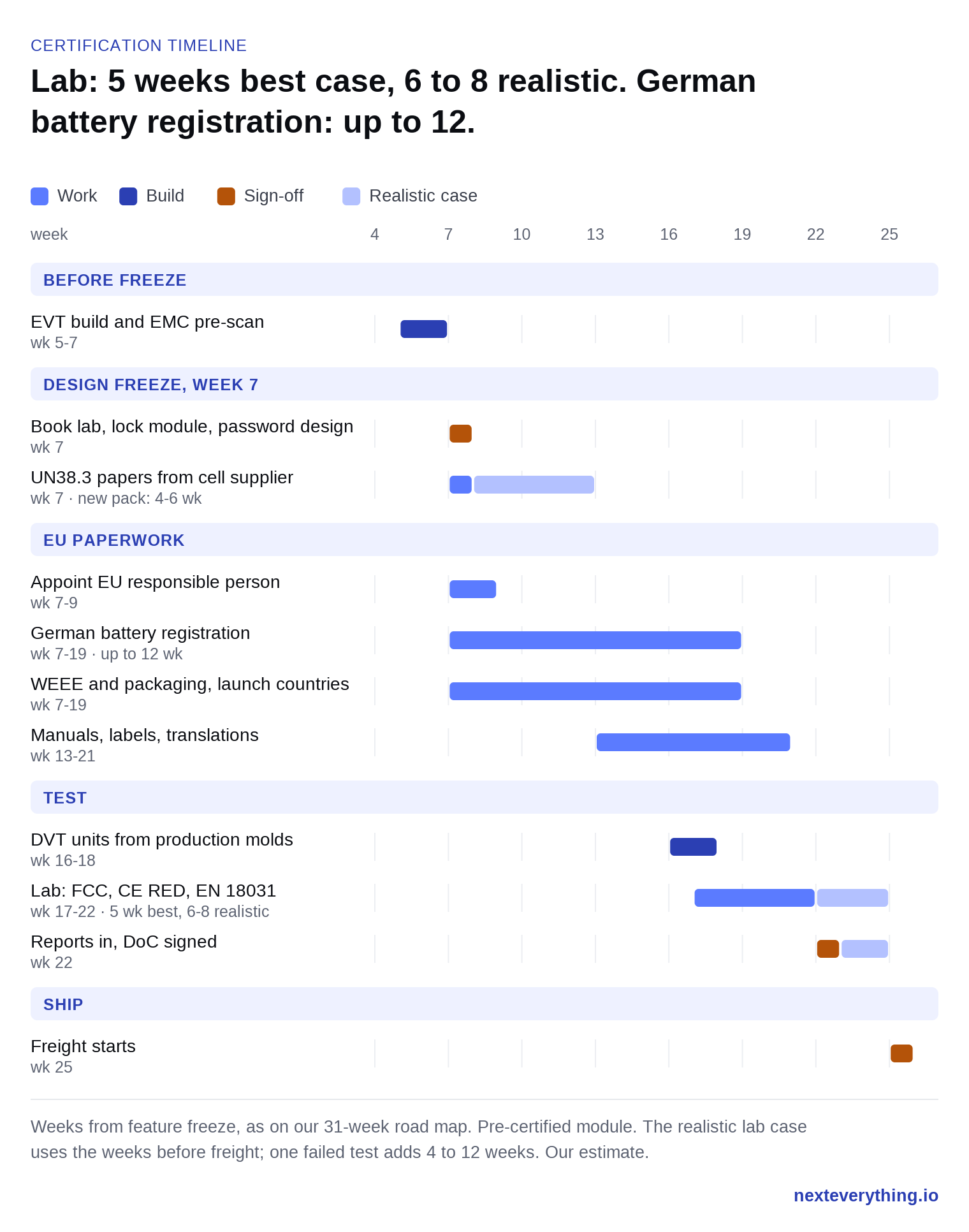
The realistic case uses all the slack before freight, so the plan holds only if the first test passes. A passed pre-scan, a lab booked at design freeze and units that match production make that likely. To fit these weeks to your own date, try our launch planner.
12How do you avoid failing?
- Pick the module for its conditions, not only its price.
- Run an EMC pre-scan on your EVT boards, while a fix is still cheap.
- Book the lab at design freeze. Labs have queues.
- Send units that match production. Use the production board, plastic and firmware. A report on a different build does not cover your product. Agree this with your factory in writing; see our guide to choosing a contract manufacturer.
- Design the password in. No skippable password, no shared default, so EN 18031 self-declaration stays open.
- Start the EU paperwork at design freeze.
- Decide battery access before the molds are cut if EU units ship after 18 February 2027.
13Pre-certification checklist
At design freeze
- Markets listed: US, and which EU countries
- Module chosen; its integration instructions and antenna list followed
- EMC pre-scan passed on EVT boards
- Lab booked; written ownership statement from the lab
- Password or unique per-device credential designed in
- Battery access decided for EU units shipping from 18 February 2027
- EU responsible person appointed; German battery and WEEE filings made
Before the first shipment
- US pre-order page carries the FCC 2.803 notice, with your refund policy
- US responsible party for the self-declaration named in writing
- Battery supplier's UN38.3 test summary on file for your exact pack
- Bluetooth qualification listed
- Registrations granted for every launch country
- Labels, manual statements and translations done; DoC signed
FAQ
Do I need FCC certification if I use a pre-certified module? Yes, but usually not your own FCC ID. You test the finished product for radio noise (Part 15B), check the radio inside it, and label it "Contains FCC ID".
Can I sell before certification? In the US, yes, with the notice required by 47 CFR 2.803, but you cannot ship until it passes. In the EU, finish the CE file before the first unit ships.
Does CE marking need a third party? Usually not. You test at a lab and self-declare. You need a notified body for the radio or cybersecurity rules if you do not fully apply the European standards there, for example if users can skip setting a password.
How long does certification take? Lab testing takes 5 weeks best case and 6 to 8 weeks realistic (our estimate). German battery registration takes up to 12 weeks.
Who we are
Next Everything is three co-founders who help hardware teams get from a working prototype to a first small series. Stan Rajm owns the plan: dates, budget and decisions. Simon Tański runs engineering; he is ex-Bosch and built a food printer by hand. Filip Hanasz handles suppliers, quotes and factory visits. In a free 30-minute call we go through your certification plan, tell you where it could slip and how to stop that.
This guide explains common rules for a simple Bluetooth gadget with a lithium-ion battery sold in the US and EU, as of November 2026. It is general information, not legal advice. Rules depend on your exact product and markets and they change. Check your product with a test lab, a compliance specialist or a lawyer before you commit.
14Sources
US law and FCC guidance
- 47 CFR (eCFR, text as of 1 November 2026): 2.803 marketing and pre-orders, 2.906 SDoC test labs, 2.909 responsible party, 2.1033 certification filings, 2.1077 compliance information, 15.19 labels, 15.101 unintentional radiators, 15.103 exempt devices, 15.201 intentional radiators, 15.212 modular transmitters
- FCC KDB 996369 D04, Module Integration Guide: apps.fcc.gov/kdb (search 996369)
- FCC, Third Report and Order on test lab recognition, FCC 26-73, adopted 29 October 2026: docs.fcc.gov
- 49 CFR 173.185, lithium cells and batteries: eCFR
EU law
- Radio Equipment Directive 2014/53/EU, Art. 3, 10, 17, 20 and Annex V: EUR-Lex
- Delegated Regulation (EU) 2022/30 (RED cybersecurity): EUR-Lex, repealed from 11 December 2027 by Delegated Regulation (EU) 2026/339: EUR-Lex
- Implementing Decision (EU) 2025/138 (EN 18031 listing): EUR-Lex
- Cyber Resilience Act, Regulation (EU) 2024/2847, Art. 13, 14, 69, 71: EUR-Lex
- EMC Directive 2014/30/EU: EUR-Lex; Low Voltage Directive 2014/35/EU: EUR-Lex; RoHS 2011/65/EU: EUR-Lex
- Market Surveillance Regulation (EU) 2019/1020, Art. 4: EUR-Lex; General Product Safety Regulation (EU) 2023/988, Art. 2 and 19: EUR-Lex
- Batteries Regulation (EU) 2023/1542, Art. 11, 55, 56: EUR-Lex, with Delegated Regulation (EU) 2026/1770 (exceptions): EUR-Lex; Packaging Regulation (EU) 2025/40, Art. 45: EUR-Lex
- German ElektroG s.6 and s.8; German BattDG s.4 and s.5
Industry, labs and transport
- IATA, Lithium Battery Guidance Document, revised for the 2026 regulations: iata.org
- Compliance Testing, FCC certification cost: compliancetesting.com
- Epec, UN38.3 for lithium batteries (2021): blog.epectec.com
- Ekoniq, EU EPR service price calculator (2026): ekoniq.eu
- Bluetooth SIG, dues and fees, effective 1 March 2026: bluetooth.com, and qualification: bluetooth.com