
Contents
In short
- A mold pays off somewhere between 400 and 800 units of a typical handheld part (LA NPDT). Below that, 3D printing is cheaper.
- A simple two-shell gadget enclosure needs two molds. In China, in P20 steel, we estimate USD 10,000 to 19,000 for the pair, all in. That is USD 11 to 22 per enclosure at 1,000 units and USD 3 to 7 at 5,000.
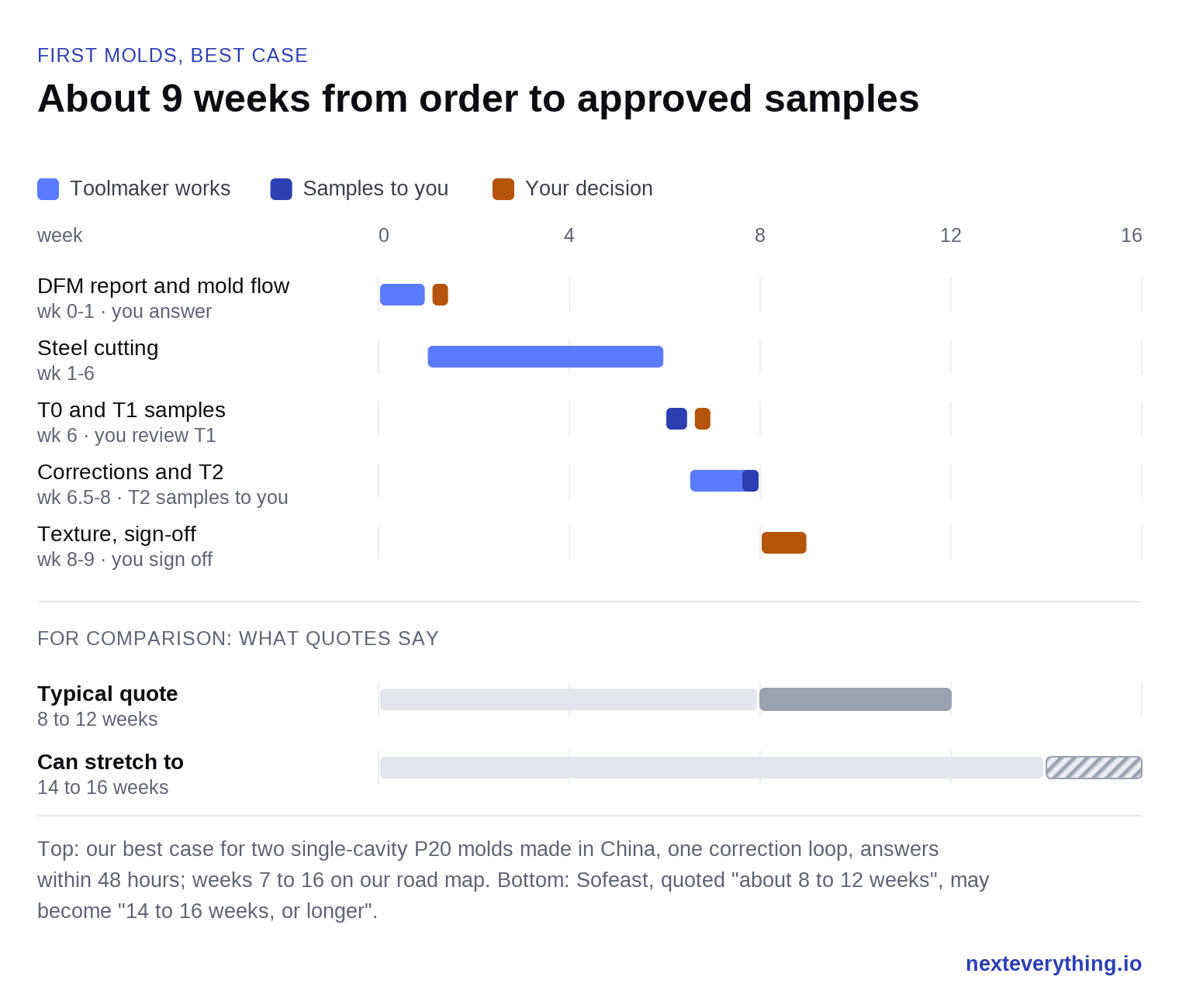
- Best case, the molds take about 9 weeks from order to approved samples. Quotes say 8 to 12 weeks. Without fast reviews and a written start date they can stretch to 14 to 16; section 4 shows how to prevent that.
- You pay for the mold, but the factory holds it. Put ownership in writing before you pay the deposit.
An injection mold for one small plastic part costs from about USD 1,500 for a simple aluminum tool to USD 100,000 for a high-volume steel one. For a startup's first gadget, two molds in China cost an estimated USD 10,000 to 19,000 and take about 9 weeks, best case. Below 400 units, printing usually wins.
This post is for a team with a 3D-printed enclosure that works and a first run of 1,000 to 5,000 units coming up. Molds are weeks 7 to 16 of our 31-week road map from prototype to backers; this post zooms into them.
1Do you need injection molding yet?
Only when your volume pays back the mold. Molding gives the cheapest part and the best finish, but you pay thousands up front.
| Process | One-time cost | Good for |
|---|---|---|
| 3D printing (SLS or MJF: nylon powder fused by laser or heat) | None. Each shell costs USD 8 to 30 from Chinese services (our estimate) | 1 to a few hundred units |
| Urethane casting (resin poured into a silicone mold) | USD 200 to 3,000 per silicone mold, good for about 10 to 30 parts (RJC Mold) | 10 to 100 units that must look molded. Casting buys looks, not price |
| Aluminum mold ("soft tooling") | From USD 1,495 at Protolabs (Protolabs) to USD 12,000 (LA NPDT) | A few hundred to tens of thousands of parts |
| Steel mold ("hard tooling") | USD 5,000 to 100,000 (Formlabs) | Thousands to millions of parts |
One US molder puts the break-even for a typical handheld part "somewhere between 400 and 800 units" (LA NPDT). Our model agrees: the mold curves cross the printing line at about 420 units (aluminum) and 510 units (steel).
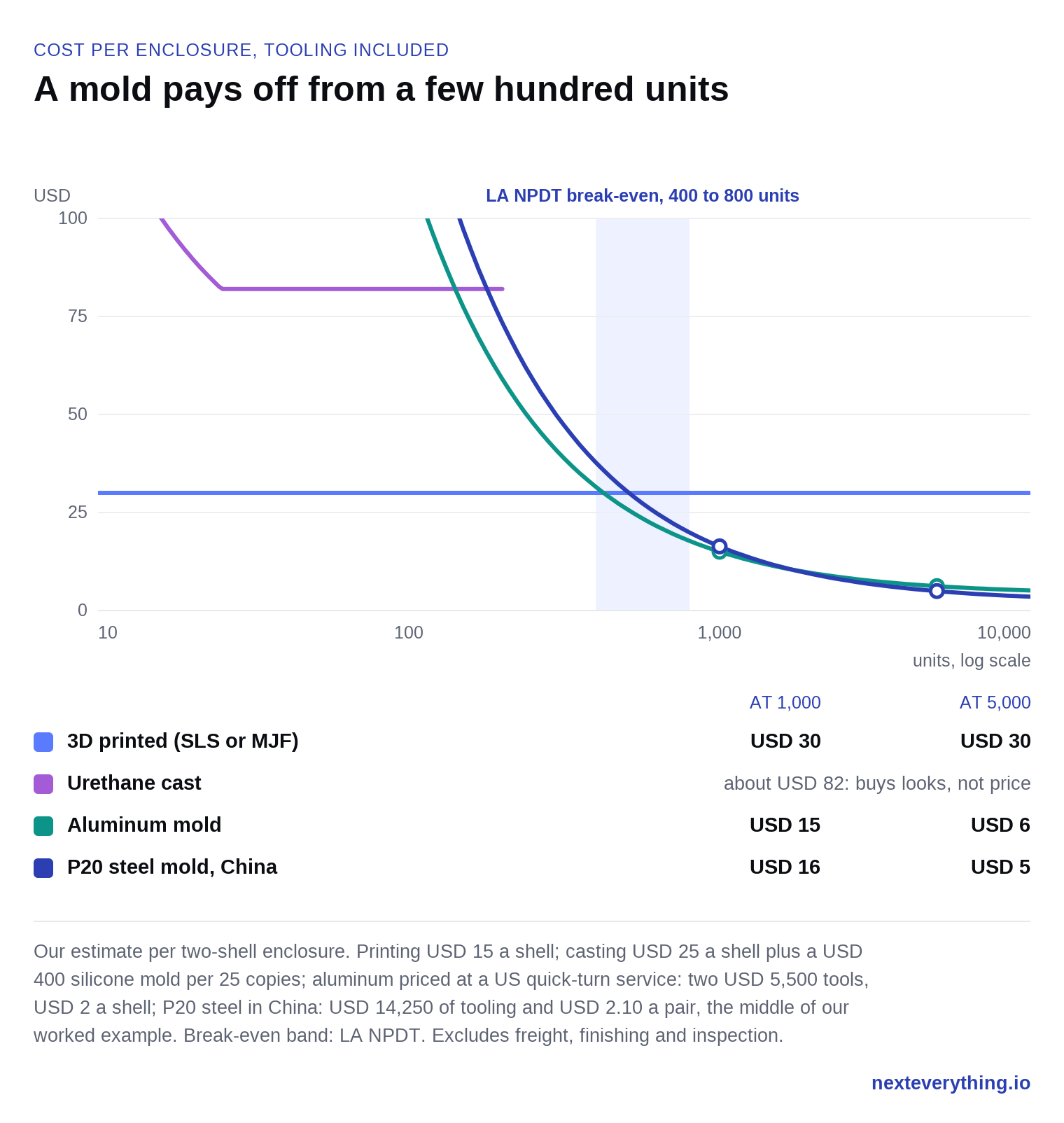
Our advice: print or cast for the crowdfunding video and the first 50 beta units, and cut molds once the design is frozen. Every change after the steel is cut costs money and weeks.
Vocabulary
Here are the terms you will meet in quotes.
| Term | What it means |
|---|---|
| Mold, tool | The metal block that molten plastic is injected into. Toolmakers use both words. |
| Cavity side and core side | The two halves of the mold. The cavity side forms the outside of the part, the core side the inside. |
| Cavity | Also the part-shaped hollow inside the mold that the plastic fills. One cavity makes one part each time the mold opens. |
| Parting line | Where the two halves meet. It leaves a faint line on the part. |
| Gate | Where plastic enters the part. It leaves a small mark. |
| Draft | A slight taper on walls so the part slides out. |
| Undercut | A hook, hole or lip that stops the part coming straight out. |
| Side action (slide) | A moving block inside the mold that forms an undercut and pulls away before the part is pushed out. |
| DFM report | The toolmaker's design for manufacturing review of your part, before steel is cut. |
| T0, T1, T2 | Mold trials. T0 is the toolmaker's own first run, T1 the first samples you receive, T2 the samples after corrections. |
| Steel safe | Designing so later fixes only remove steel from the mold, which is easy. Adding steel back is not. |
| Golden sample | The signed reference part every production part is checked against. |
2How does an injection mold work?
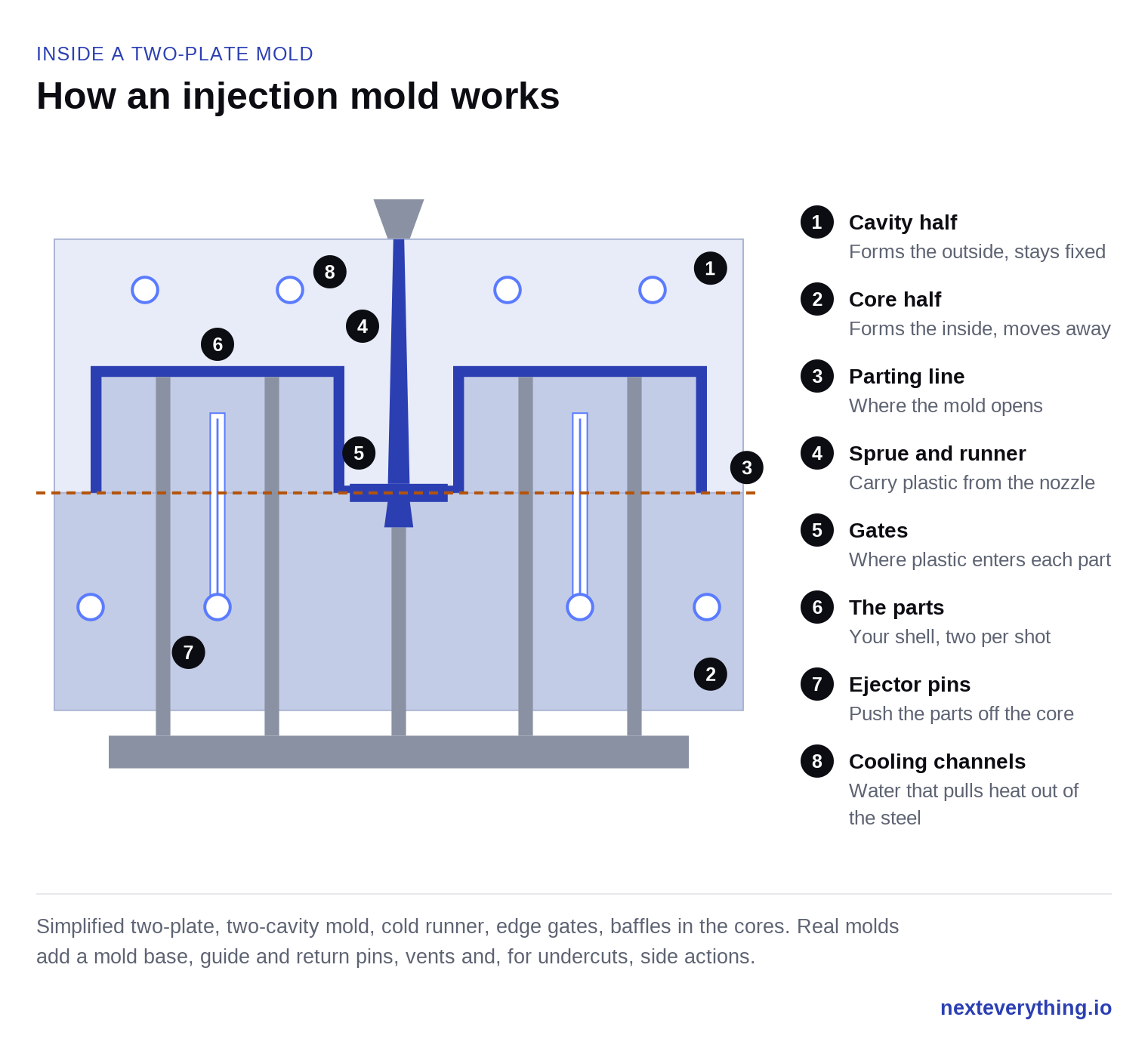
A mold is two steel halves clamped together with a part-shaped hollow between them. The machine pushes molten plastic in, waits for it to cool, opens the halves and pushes the part out. Then it closes and does it again, usually in under a minute for a small part. Press play to watch one cycle, or drag to turn the mold.
3What does a first injection mold cost?
For a simple gadget, an estimated USD 10,000 to 19,000 in China for both molds, all in. Our example is a palm-sized enclosure: a top shell and a bottom shell in ABS/PC (a tough, common blend of two plastics), a light matte texture, and a USB-C opening in the bottom shell that needs one side action. Single-cavity molds in P20, a pre-hardened steel, made in China, for 1,000 to 5,000 units.
| Line | Low | High |
|---|---|---|
| DFM report and mold-flow simulation | Often included | USD 1,000 if billed |
| Top shell mold, P20, single cavity | USD 4,000 | USD 6,500 |
| Bottom shell mold, P20, single cavity, one side action | USD 5,000 | USD 8,000 |
| Light texture on both molds | USD 400 | USD 1,000 |
| Courier for T1, T2 and final samples | USD 300 | USD 800 |
| Trials beyond those in the quote | USD 0 | USD 1,500 |
| Total tooling | USD 9,700 | USD 18,800 |
All lines are our estimate. A side action costs USD 800 to 2,500 at one US molder (LA NPDT), and we priced the bottom mold with that in mind.
The molded parts cost little: we estimate USD 1.20 to 3.00 for the pair, inside the USD 0.60 to 4.00 per part that LA NPDT quotes. What decides your unit cost is how many units share the tooling.
| 1,000 units | 5,000 units | |
|---|---|---|
| Tooling per unit | USD 9.70 to 18.80 | USD 1.94 to 3.76 |
| Molded shells per unit | USD 1.20 to 3.00 | USD 1.20 to 3.00 |
| Enclosure cost per unit | USD 11 to 22 | USD 3 to 7 |
| Printed shells instead (our estimate) | USD 16 to 60 | USD 16 to 60 |
Three things move these numbers most. A design that skipped a DFM review can draw a quote 20 to 40 percent higher (LA NPDT). Each extra undercut adds a side action. And a full gadget usually has more than two molded parts: buttons, a light pipe, a battery door. In our road map we estimate 4 to 7 molds and USD 15,000 to 45,000 in China for a whole gadget.
Plan the cash. A common term is 50 percent of the tooling price up front and the balance when you approve the samples; one Shenzhen toolmaker's published terms say exactly that. So half the money leaves weeks before you hold a part.
Which type of mold do you need?
For 1,000 to 5,000 units of a small enclosure: one cavity, aluminum or P20 steel, cold runner. Name each choice in every quote, because each one moves the price.
Aluminum or steel. Aluminum machines 3 to 10 times faster than steel (Fictiv), and quick-turn services like Protolabs use it. Protolabs guarantees its prototype tools for at least 2,000 shots (injection cycles); a well-built aluminum tool can reach 50,000 to 100,000. Steel lasts longer: P20 around 300,000 shots, hardened H13 a million or more (Sofeast). Any tool made in China costs less: Sofeast puts the saving at upwards of 40 percent against a typical European or US tool. If a quote for a 2,000-unit gadget says SPI Class 101 (the US industry grade for a mold built for a million cycles), the shop misunderstood your volume (Texas Injection Molding).
One cavity or several. A cavity is one part-shaped hollow in the mold. A single-cavity mold makes one part each time it opens. A 4-cavity mold has four identical hollows and makes four parts per cycle, so the machine runs a quarter as long for the same order. That speed costs more steel and machining up front. In one Protolabs quote a 4-cavity tool cost 3.2 times the single-cavity one, and only paid off above about 18,700 parts (Innovation Works). At 1,000 to 5,000 units, start with one.
Family mold. One tool for both shells is cheaper. It only works when both parts share plastic and color and are similar in size; otherwise the large part can fill short while the small one gets flash, thin excess plastic at the edge (Team Rapid Tooling). It also ties the two parts together: a fix to one stops both.
Hot or cold runner. The runner carries plastic to the gate. A hot runner keeps it molten and wastes less, but costs more to build and maintain; a cold runner's plastic is scrapped or reground each cycle, and it is often preferred for its low setup cost (Xometry). At startup volumes, cold.
4How long does a first mold take?
About 9 weeks from order to approved samples, best case. On our road map that is weeks 7 to 16. Quotes commonly say 8 to 12 weeks and can stretch to 14 to 16 or longer (Sofeast). The difference is mostly in how fast you answer.
Week 0 to 1DFM report and mold flow
You send the frozen CAD (3D design) files and pay the deposit. The toolmaker returns a DFM report on draft, walls, undercuts, gate and parting line, plus a mold-flow simulation used to place the gate so weld lines form where they bond well and air can escape (Autodesk Moldflow). Answer it within days. It is your last cheap chance to change the part.
Week 1 to 6Steel cutting
The toolmaker machines the cavity and core, burns fine details by EDM (electrical discharge machining, a spark-erosion process), and fits the pins and slides. Hubs puts mold making at 4 to 6 weeks (Hubs). Get the machining start date in writing: Sofeast notes the tooling clock "usually does not start when the purchase order is placed or the deposit is paid".
Week 6T0 and T1
T1 is the first run under production-like conditions and the first samples you see (Fictiv). Fictiv calls perfect parts on the first run "nearly impossible". So plan a day to measure the samples, fit the board and buttons, and send one list of fixes.
Week 6 to 8Corrections and T2
The toolmaker removes steel to fix dimensions, sink marks (shallow dents over thick areas) and flash, then shoots T2. By our estimate each loop takes 1 to 3 weeks including shipping samples. Ask how many trials the quote includes before you sign (Team Rapid Tooling).
Week 8 to 9Texture and sign-off
Texture goes on after the shape is approved; Fictiv notes final textures are sometimes left out of the first trials. Then you approve against a written spec (dimensions, cosmetic grade, color), sign a golden sample and pay the balance. Sofeast advises against signing off early and treats T0 to T2 as checkpoints (Sofeast). On our road map, DVT units (the first build from production molds) come from these approved parts at week 16.
Read the sign-off terms, too. One toolmaker's terms treat the samples as approved, and the balance as due, if you send no feedback within 30 days of the latest sample shipment (published terms). Put review dates in your plan, so approval is always your decision.
What makes it slip, and how a plan prevents it
Many tooling delays start on the buyer's side (Sofeast), and each one has a fix you can put in the plan.
| What slips | How the plan prevents it |
|---|---|
| DFM questions sit unanswered | One named engineer answers within 48 hours; review dates are in the schedule (our recommendation) |
| A design change after steel is cut | Freeze the CAD after printed or cast parts pass fit and drop tests; design steel safe |
| Machining starts weeks after the deposit, or trials run over | The quote states the steel start date, the T1 date and how many trials are included |
| Chinese New Year or Golden Week | Holidays on the calendar before you set T1 |
5Who owns the mold?
You do, if the contract says so. You pay for the mold, but it sits in the factory, and that is leverage. China lawyers Harris Sliwoski put it plainly: "Possession gives the factory leverage even when your ownership claim is strong" (Harris Sliwoski).
A paid invoice that says "mold fee" may not settle the question. Some factories accept that you own the physical mold but claim the design inside it, or hold the mold back until you pay for CAD work, testing or revisions the price supposedly did not include.
Read the toolmaker's standard terms before you order. Published terms like these are normal and useful, because they tell you what happens by default. The Shenzhen toolmaker quoted above, for example, transfers ownership of the molds only once all payments are received, keeps the tools with it at the buyer's risk, and stores rapid tooling for 36 months after the first molding order unless agreed otherwise, after which the tools may be destroyed. If your reorders may be years apart, agree storage in writing.
What a tooling agreement should cover (the same firm publishes a template tooling ownership agreement you can start from):
| Term | What it says |
|---|---|
| Ownership | You own the molds and the design in them (an intellectual property assignment, not only the steel) |
| Marking | Permanent, visible markings with your company name and a unique asset ID on each mold |
| Location and records | Where each mold is kept, plus an inventory form with serial numbers, photos and specs |
| Exclusive use | No parts for anyone else, and no third-party production from your molds |
| Subcontracting | The factory needs your written approval before a mold goes to another shop |
| Maintenance | The factory maintains the molds and covers minor repairs |
| Return and transfer | A notice period, a release deadline, exactly what gets delivered, and penalties for delay |
| Payment | Paying for tooling up front, with written ownership terms, protects you best. Tooling paid inside the part price needs strong paperwork |
For a costly tool, consider contracting with the mold maker directly, or a three-party agreement between you, the product factory and the mold shop. Photograph each mold with its marking at sign-off. Put these tooling terms inside your manufacturing agreement, signed before you pay for tooling (see our guide to choosing a contract manufacturer). If the factory is in China, sign a China-specific NNN agreement (non-disclosure, non-use and non-circumvention) before you share files, and make it cover the factory's related companies and subcontractors. Write the contract so it can be enforced where the mold is. A US-style contract that sends disputes to a distant court may give you rights only on paper: the language, governing law and dispute forum decide whether you get the mold back in time.
6Which design rules matter before you order?
Everything in the part has to come out in the direction the mold opens, or the mold needs side actions. And thick areas cool slowly and shrink more, which shows up as sink marks and warp. Five rules follow, and getting them right in CAD turns the DFM report into a short list instead of a redesign.
- Even walls. For ABS, Protolabs recommends 0.045 to 0.140 inch, about 1.1 to 3.6 mm (Protolabs). For a palm-sized shell we would start at 1.5 to 2.5 mm (our estimate). Hollow out thick spots.
- Draft on every vertical face. At least 0.5 degrees, about 1 degree per inch of depth, and 3 degrees under a light texture (Protolabs).
- No needless undercuts. Move a USB-C opening to the parting line, or add a pass-through hole so steel can reach a snap hook from both sides. Each side action you keep costs money and can wear.
- Thin ribs and bosses. Ribs at 40 to 60 percent of the wall they join (Protolabs), and screw bosses the same, supported by small gussets (Protolabs). Fat ones leave sink marks on the face your customer sees.
- Steel safe. "You may be able to thicken a wall, but making it thinner requires remaking the mold" (Protolabs). Where fit is uncertain, leave less plastic, so fixes after T1 only remove metal.
One rule comes from the law. From 18 February 2027, products sold in the EU with a portable battery must let the user remove and replace it with ordinary tools (Regulation (EU) 2023/1542, Art. 11). Narrow exceptions exist, for example washable devices and small or sealed wearables (Delegated Regulation (EU) 2026/1770), and they only apply where safety requires it. Even then, an independent repairer must still be able to replace the battery. If your units ship after that date, decide on battery access before design freeze, not after the molds are cut. A battery door or screw access is new geometry in the bottom shell, and adding it later means new steel.
7How do you choose a molder?
Send the same CAD, volumes and spec to three to five shops, and pick the one that answers most of these in writing. EveryJobShop, the factory directory we built, lists molders by country and process. It is a starting point; a listing is not proof of capability.
- Which steel, how many cavities, which runner type and how many side actions did you price?
- Are the DFM report and a mold-flow simulation included?
- When does machining start, and when do T1 samples ship?
- How many trial rounds are included, and what does an extra one cost?
- Who pays for corrections caused by the toolmaker, and who pays for those caused by our design change?
- What shot life do you guarantee, and who repairs the mold within it?
- Will you sign our tooling ownership agreement, mark the molds and send photos?
- Which similar consumer enclosures have you made, and can we see sample parts?
A shop that answers only with a price is telling you how the next 9 weeks will go.
Before you pay the deposit
The questions above cover the quote. These cover your side:
- Design frozen after printed or cast parts passed fit, drop and assembly tests
- Walls, draft, ribs and bosses checked against the rules in section 6; steel-safe margins where fit is uncertain
- Battery access decided for EU units shipping from 18 February 2027
- One engineer named to answer the DFM report and T1 samples within 48 hours
- Cash planned for 50 percent now and 50 percent at sample approval
- Chinese New Year and other holidays on the tooling calendar
For the rest of the launch, our launch checklist covers boards, certification and freight. Certification runs alongside tooling; see FCC and CE certification for hardware startups.
FAQ
How much does an injection mold cost per unit? For a two-shell enclosure made with P20 steel molds in China, we estimate USD 11 to 22 per unit at 1,000 units and USD 3 to 7 at 5,000, tooling included.
How long does an injection mold last? Aluminum tools are guaranteed for at least 2,000 shots at Protolabs and can reach 50,000 to 100,000. P20 steel lasts around 300,000 shots and H13 a million or more.
Can I change the design after the mold is made? Yes, if the change removes steel, such as thickening a wall or adding a rib. A thinner wall or a bigger hole needs steel added back, which usually means a new mold.
Should I make my mold in China or near home? China is cheaper, but the mold stays far away, so the ownership agreement matters more. In our view, a local aluminum mold costs more but is quicker to fix. Either works for a first run.
Can I take my mold to another factory? Agree that before you order: return rights, a release deadline and exactly what gets delivered. Without those terms in writing, the factory that holds the mold has the leverage.
Who we are
Next Everything is three co-founders who help hardware teams get from a working prototype to a first small series. Stan Rajm owns the plan: dates, budget and decisions. Simon Tański runs engineering; he is ex-Bosch and built a food printer by hand. Filip Hanasz handles suppliers, quotes and factory visits. In a free 30-minute call we check your tooling plan and quotes against this guide and tell you where it will slip.
This guide explains common practice for small plastic enclosures as of November 2026. Prices and lead times change with materials, regions and suppliers; treat our estimates as a planning range, not a quote. The sections on mold ownership and the EU battery rule are general information, not legal advice. Check your contract with a lawyer who works with factories in your supplier's country, and check the battery rules for your exact product before design freeze.
Sources
Costs, volumes and mold types
- Formlabs, how to estimate injection molding cost: formlabs.com
- LA NPDT, low-volume injection molding cost: lanpdt.com
- Protolabs, injection molding service (pricing, lead times, tool life): protolabs.com
- Innovation Works, how much does injection molding cost (Protolabs quotes, 2021): innovationworks.org
- Fictiv, steel vs aluminum molds: fictiv.com
- Sofeast, injection mold cost and steel grades: qualityinspection.org
- Texas Injection Molding, SPI mold classes: texasinjectionmolding.com
- Team Rapid Tooling, family molds: teamrapidtooling.com, and hidden costs: teamrapidtooling.com
- Xometry, hot runner vs cold runner: xometry.com
- RJC Mold, urethane casting cost: rjcmold.com
Design rules and regulation
- Protolabs, injection molding basics: protolabs.com
- Protolabs, draft: protolabs.com
- Protolabs, boss design: protolabs.com
- Protolabs, planning for design changes (steel safe): protolabs.com
- Regulation (EU) 2023/1542 (batteries), Art. 11: eur-lex.europa.eu, with Delegated Regulation (EU) 2026/1770 (exceptions): eur-lex.europa.eu
Process and timeline
- Autodesk Moldflow, gate location rules (weld lines, air traps): autodesk.com
- Hubs, injection molding guide: hubs.com
- Sofeast, why tooling takes longer than quoted: qualityinspection.org, and don't sign off tooling too early: qualityinspection.org
- Fictiv, mold trials: fictiv.com
- A Shenzhen toolmaker's published terms and conditions (tooling payment, sign-off, ownership, storage): hlhrapid.com
Ownership and factories
- EveryJobShop manufacturing directory: everyjobshop.com
- Harris Sliwoski, who owns your molds: harris-sliwoski.com
- Harris Sliwoski, molds and tooling, the 30 essential FAQs: harris-sliwoski.com
- Harris Sliwoski, template tooling ownership agreement: harris-sliwoski.com
- Harris Sliwoski, NDAs do not work for China but NNN agreements do: harris-sliwoski.com