
Contents
In short
- From a working prototype with its features locked to the last box on a customer's doorstep takes about 31 weeks if everything passes first time, by our estimate. Plan for 9 to 12 months.
- The first 1,000 units of a simple Bluetooth gadget cost an estimated USD 58k to 195k, before freight, fees and marketing.
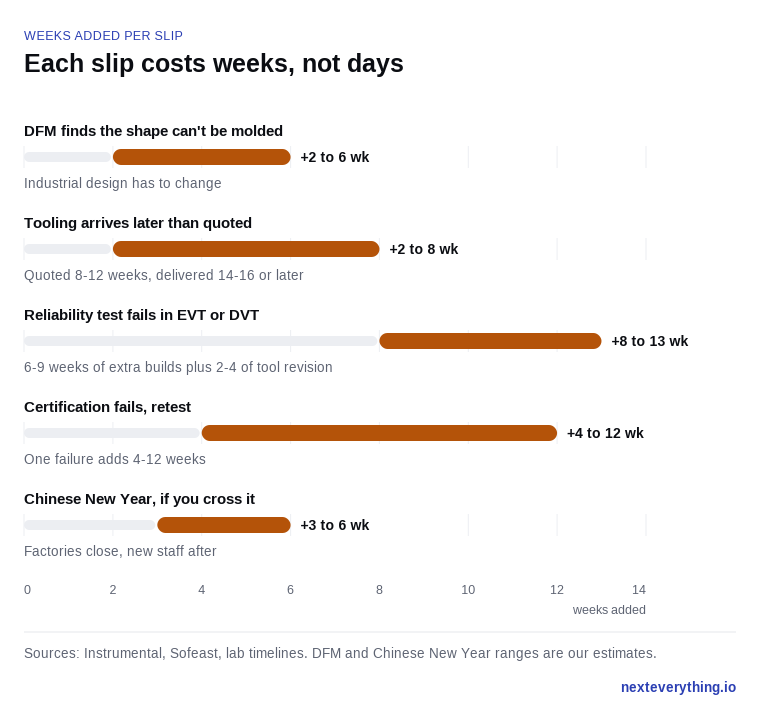
- The biggest slips, by our estimate: a failed reliability test adds 8 to 13 weeks, a failed certification 4 to 12.
- Launching after DVT (units off real molds) cuts the best-case wait for backers from about 31 weeks to about 13.
Most hardware ships late
Ethan Mollick studied Kickstarter projects and found that only 24.9 percent of the projects he sampled delivered on time (Mollick 2014). A later review of 144 funded technology campaigns found "no more than 32%" did (Jensen and Özkil 2018). Most of those delays come from steps nobody planned for. This post maps every one of them, so you can plan for them before you launch.
This post is for a team with a hand-built unit (3D-printed case, Bluetooth radio, lithium-ion battery), a crowdfunding launch coming up, and nobody who has run a production line.
We mapped the road for that product, made in Shenzhen and sold in the US and EU. Week 0 is feature freeze: the day your working prototype stops gaining features. If every build and test passes first time, customers get boxes around week 31. Plan for 9 to 12 months.
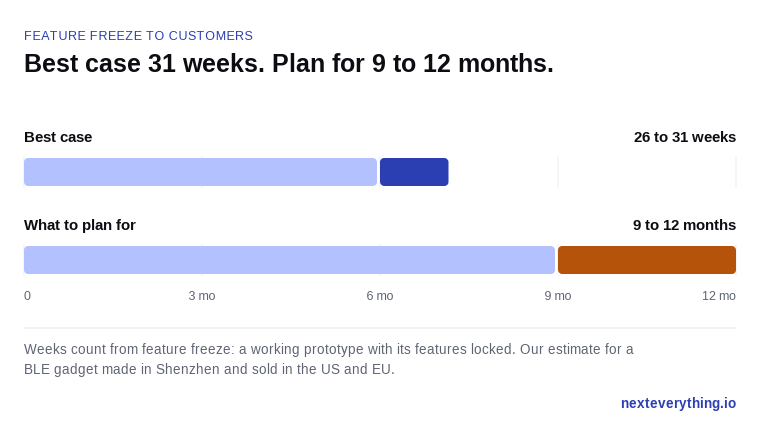
Numbers with a link come from that source. Numbers we call our estimate are ours, built from the research behind this post.
1The factory builds a different object
The factory needs a product that line operators can build a thousand times the same way, that passes a lab test, and that can be sold legally. It will look like your prototype. Underneath, most of it changes.
| Your prototype | Production-ready | |
|---|---|---|
| Enclosure | 3D printed, hand-fitted | Injection-molded, even walls, draft on every face, no undercuts |
| Electronics | Dev kit or hand-built board | Production PCB with test points and a programming header |
| Parts list (BOM) | Whatever was in stock | Approved manufacturer, second source, MOQ and lead time per line |
| Testing | You plug it in and it works | A test fixture and a written spec |
| Firmware | The build on your laptop | One versioned image, unique serial and Bluetooth MAC per unit |
| Compliance | None | FCC, CE (RED), EN 18031, UN38.3 battery papers, EU responsible person, EU producer registrations |
| The reference | Your CAD file | A signed golden sample |
2The road map, week by week
Vocabulary
Factories and labs speak in acronyms. Here is every one on the road map, in the order you meet them.
| Term | What it means |
|---|---|
| Feature freeze | The day you stop adding features. The prototype works, but it is still printed and hand-built, not yet designed for a factory. Week 0 on our road map. |
| DFM (design for manufacturing) | Reworking each part so a factory can make it fast, cheap and the same every time. |
| BOM (bill of materials) | The full parts list: every component, its maker, quantity and price. |
| MOQ (minimum order quantity) | The smallest number of a part a supplier will sell you. |
| RFQ (request for quote) | The package you send factories so they can price your product: CAD files, drawings, BOM, volumes. |
| NNN agreement | Non-disclosure, non-use, non-circumvention. Stops a factory from sharing, copying or going around you to sell your design. |
| NRE (non-recurring engineering) | One-time costs you pay before the first unit: molds, test fixtures, setup. |
| EVT (engineering validation test) | The first small build in the real form, with production boards. Proves the design works. |
| EMC pre-scan | A quick, cheap trial of the radio emissions test, so you find problems before the real lab does. |
| Design freeze | The day the design stops changing. Molds get cut after this, so every later change costs money and weeks. |
| Mold (tooling) | The steel or aluminum block that plastic is injected into to make each case part. One mold per part. |
| Draft and undercuts | Draft is a slight taper on each wall so the part slides out of the mold. An undercut is a hook or overhang that stops it. |
| T1, T2 | The first and second sets of sample parts from a new mold. You check T1, ask for steel corrections, then check T2. |
| Steel correction | Machining the mold to fix a defect in the parts. Removing steel is easy, adding it back is not. |
| Firmware image | The one tested, versioned software file the factory loads onto every unit. |
| Test fixture | A jig on the line that holds a board or finished unit and checks it in seconds. |
| Work instructions | Step-by-step sheets, with photos, that tell each line worker exactly what to do. |
| Drop test | Dropping the packed product from set heights to check that it and the box survive shipping. |
| DVT (design validation test) | Units made from the production molds. They go through reliability tests and to the certification lab. |
| Golden sample | The signed reference unit. Every production unit gets checked against it. |
| PVT (production validation test) | The pilot run: a small batch on the real line at real speed, to prove the factory can build it. |
| FCC Part 15 | US rules for electronics that give off radio energy. Most gadgets must pass testing under them before units can reach US buyers. |
| CE, RED | CE marking shows a product meets EU rules. For anything with a radio, the main one is the Radio Equipment Directive (RED). |
| EN 18031 | The standard used to show a connected radio product meets the EU's cybersecurity rules under RED. |
| UN38.3 | The UN test series a lithium battery must pass before it can be shipped. |
| EU responsible person | A company based in the EU that answers to the authorities for your product if you are based outside it. |
| EPR, WEEE | Extended producer responsibility. In each EU country you sell into, you register and pay toward recycling of electronics (WEEE), batteries and packaging. |
The map
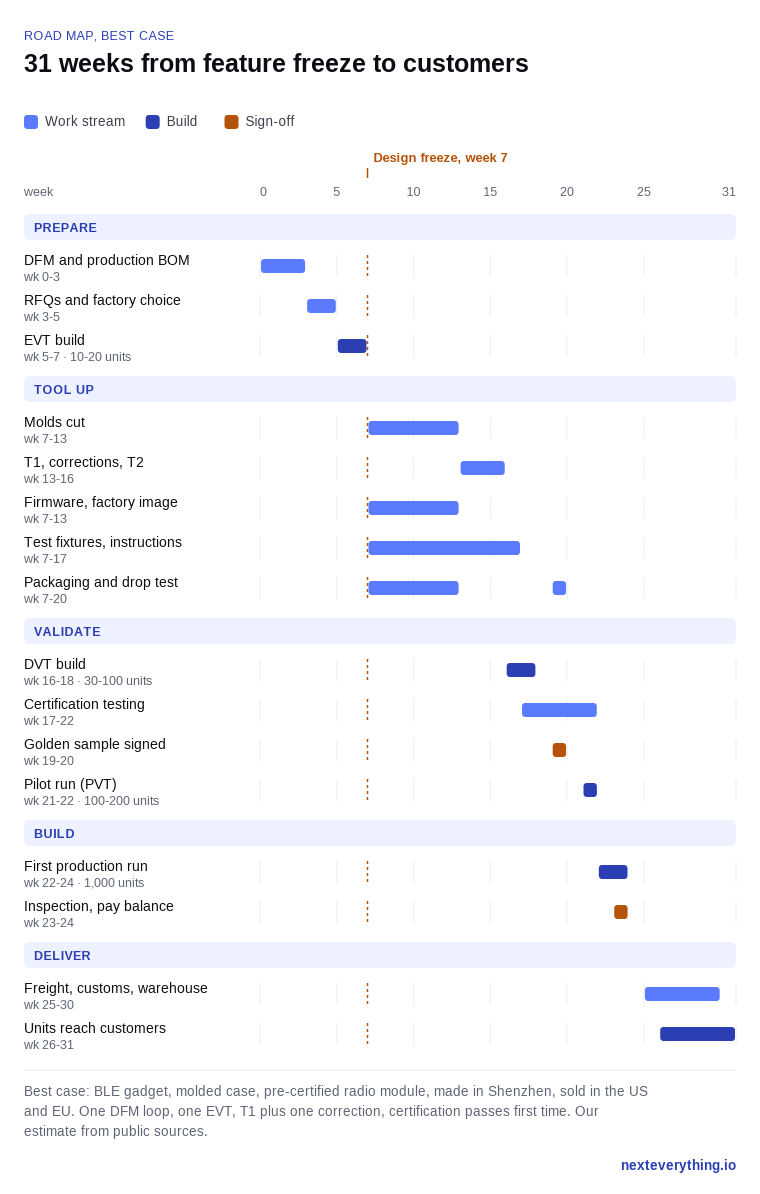
The map assumes one DFM loop, one EVT build, one round of mold corrections and a certification that passes first time. It is the best realistic case, not the typical one.
Weeks 0 to 7Get ready
First, DFM (design for manufacturing): every part gets checked against the way it will be made. Molded parts need even walls, draft (a slight taper so the part leaves the mold) and no undercuts. Boards need test points. Your parts list becomes a production BOM with a second source, a minimum order quantity (MOQ) and a lead time on each line. This costs an estimated USD 10,000 to 50,000. If DFM forces an industrial design change, add 2 to 6 weeks (our estimate).
Then send the same quote package to 3 to 5 suppliers: STEP files, drawings with tolerances, the BOM, board files, test specs and volumes with price breaks (say 500, 2,000 and 5,000). Sign an NNN agreement first (non-disclosure, non-use, non-circumvention). China lawyers recommend it instead of a US-style NDA (Harris Sliwoski). Compare quotes line by line, with one-time costs (NRE: molds, fixtures, setup) split from the unit price.
Around week 5 you build 10 to 20 EVT units with production-intent boards in cast or printed cases. Test function, drops, heat and the battery. Run an EMC pre-scan, a trial of the emissions test that costs a few hundred to a couple of thousand dollars (our estimate). It is cheap insurance against failing the real test.
Week 7: design freeze. You pay the tooling deposit (commonly 50 percent with the order, 50 percent on approval of first samples), order long-lead parts like batteries and radio modules, and book the certification lab. Labs have queues.
One decision has to come before this point. From 18 February 2027, products sold in the EU with a portable battery must let the user remove and replace it with ordinary tools (Regulation (EU) 2023/1542, Art. 11). Narrow exceptions exist, for example washable devices and small or sealed wearables (Delegated Regulation (EU) 2026/1770), and they only apply where safety requires it. Even then, an independent repairer must still be able to replace the battery. If your units ship after that date, decide on battery access before design freeze, not after the molds are cut.
Weeks 7 to 16Molds
By our estimate, a gadget like ours needs 4 to 7 molds: top shell, bottom shell, buttons, light pipe and so on. For a few thousand units, single-cavity tools in aluminum or P20 steel are enough. Formlabs puts an aluminum mold for 1,000 to 5,000 units at USD 2,000 to 5,000 each (Formlabs). We estimate USD 15,000 to 45,000 for the whole set in China. Buyers often hear 8 to 12 weeks for complete tooling, which can quietly become 14 to 16 or longer (Sofeast). Put tool ownership in the contract: you own the molds, they stay at the named factory, and nobody else uses them.
Around week 13 the first parts arrive (T1). Expect short shots, flash, sink marks and warp. You ask for steel corrections and get T2. Each loop takes an estimated 1 to 3 weeks. Ask how many trials the quote includes, and design "steel safe": a wall can be thickened later, but making it thinner needs a new mold (Protolabs).
Small defects cost real time. Moasure told its backers that its first tool samples had "a few minor issues - which is normal with injection molding" (Moasure backer update). The fix cost the team its window before Chinese New Year and a three-week slip.
Meanwhile someone builds the test fixture: a nest that holds the board, with spring pins on its test points and a small computer that flashes it, checks it and prints pass or fail. Expect an estimated USD 1,000 to 5,000 per fixture in China. It is the only thing that tells the factory what "working" means.
Weeks 16 to 22Prove it on real parts
DVT is 30 to 100 units from real molded parts. They go to the lab, so they must match production exactly: same board, same plastic, same firmware radio settings. Instrumental advises expecting "at least one or two critical problems" per program, and shows a failed reliability test adding "6-9 weeks of additional builds plus 2-4 weeks of tool revision" (Instrumental).
Then you and the factory sign the golden sample, the physical reference for color, gloss and fit. Keep one at your office and one sealed at the factory. The pilot run follows: 100 to 200 units on the real line. Check the yield (the share that pass) and fix what fails. One US product development firm puts a pilot of 50 to 500 units at USD 5,000 to 30,000, "often at 2-4x unit cost" (LA NPDT).
Weeks 17 to 25Certification
You cannot ship the product to buyers until it passes. You can take US pre-orders before then, but only with a clear notice that delivery depends on passing FCC rules and what happens to the money if it does not. Certification runs in parallel with the pilot. Book the lab at design freeze (week 7), because labs have queues.
From week 17 an accredited lab tests your DVT units. A pre-certified radio module covers the radio, but you still test the finished product as an "unintentional radiator" under FCC Part 15B and label it "Contains FCC ID". For the EU you need CE marking under the Radio Equipment Directive (RED). Since 1 August 2025 RED also has cybersecurity requirements for radio products that connect to the internet, directly or through a phone app, and for wearables, toys and childcare products that handle personal data. The harmonized standard EN 18031 is the usual way to show you meet them. The battery needs UN38.3 transport test papers, which your battery supplier should provide.
One US lab lists USD 4,900 to 10,000 for FCC certification with a pre-certified module (Compliance Testing). All in, with the EU side, we estimate USD 12,000 to 25,000. Failing costs more than the fee: one retest adds 4 to 12 weeks, by our estimate. The lab can run to week 25 without moving the customer date, because freight starts then.
One new rule. On 29 October 2026 the FCC voted to stop recognizing test labs outside the US and economies with a mutual recognition or similar reciprocal agreement. Mainland China is not on the list (Hong Kong and Taiwan are). Applications filed from 1 December 2028 must use testing from a recognized lab in those places; certifications granted before then stay valid (FCC 26-73). The rule covers FCC certification. Part 15B testing under a supplier's declaration, the usual route for a product built on a pre-certified module, is not changed for now, though the FCC is still considering it. If your product needs its own FCC ID, plan that testing outside mainland China for anything filed from December 2028.
Start the EU paperwork at design freeze too. Producer registrations are separate from CE marking, and Germany's battery registration can take up to 12 weeks after a complete filing. Section 5 explains what to file.
Weeks 22 to 24Build the first 1,000
Boards are assembled and flashed. Each unit gets tested, burned in for an estimated 1 to 4 hours, labeled and packed. Then an independent inspector checks a sample. For 1,000 units at the usual AQL 2.5 setting, that is 80 units, and the lot passes with up to 5 defects (HQTS). The units cost an estimated USD 15 to 40 each. Standard Chinese terms are 30 percent before production and 70 percent before shipment (QualityInspection.org). Tie the 70 percent to passing inspection. It is your main lever.
Weeks 25 to 31Ship
Ocean freight from Yantian to Los Angeles takes 15 to 18 days port to port, plus 3 to 7 days to the door (GoFreight). With customs and warehouse intake we allow 4 to 6 weeks (our estimate). A 40-foot container on that lane ran USD 2,200 to 3,500 all in, mid-2026.
Have the battery's UN38.3 papers ready: transport rules require them, and forwarders refuse batteries without them.
Flying everything when you are late is tempting. Dave Millman of Predictable Designs: "Deciding to use air freight to get the product here sooner has flipped more products from profit to loss than any other single factor." (Predictable Designs)
3When to launch
Your campaign date does not change the factory calendar. It decides how much of it backers watch.
At feature freeze (week 0). Backers wait about 31 weeks in the best case, and every surprise becomes a public update. You get cash early, which may pay for the molds.
After design freeze (week 7). By then the design has been reworked for the factory and tested in its real form, and your price rests on real quotes. The best-case wait is about 24 weeks.
After DVT (week 18). Campaign units come off real molds. The wait drops to about 13 weeks and the biggest risks are behind you. The catch: you fund molds and DVT up front, from your own money, investors or pre-orders.
The same review analyzed 114 of the funded campaigns in detail: 43 percent were more than a year late (Jensen and Özkil 2018).
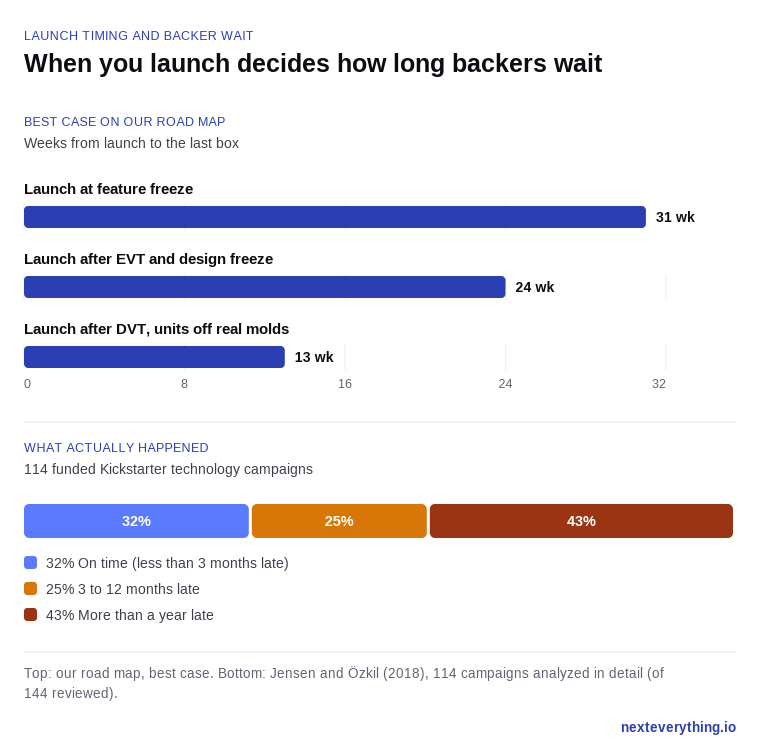
If you launch early, set the ship date from the 9 to 12 month plan, not the 31-week best case.
4The budget
For a simple Bluetooth gadget with a pre-certified module, one board and a molded case, 1,000 units:
| Cost block | Estimated range |
|---|---|
| Engineering and DFM | USD 10,000 to 50,000 |
| Molds, 4 to 7 tools in China | USD 15,000 to 45,000 |
| Test fixtures | USD 1,000 to 5,000 |
| Certification and registrations, US and EU | USD 12,000 to 25,000 |
| Pilot run, 50 to 500 units | USD 5,000 to 30,000 |
| First 1,000 units (USD 15 to 40 each) | USD 15,000 to 40,000 |
| Freight, duties, fulfillment | 10 to 20 percent of product cost |
| Crowdfunding fees (Kickstarter) | 8 to 10 percent of the raise |
| Contingency | 10 to 20 percent |
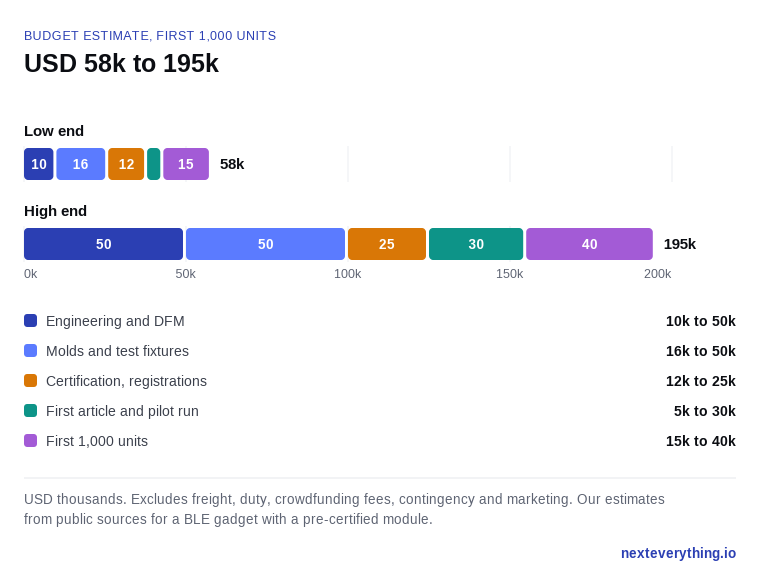
The first six lines add up to USD 58,000 to 195,000. The certification line leaves out the Bluetooth listing fee: at the free Adopter membership level it is up to USD 12,000 per new design as of March 2026. A custom radio or custom battery pack can push certification alone well past USD 50,000 (Predictable Designs).
Molds and certification do not scale down. USD 25,000 of molds is USD 50 per unit at 500 units and USD 5 at 5,000. So price from landed cost (factory price plus freight, duty, inspection, molds and certification spread over units), not from parts cost. If you sell through retail or Amazon with ads, our rule of thumb is that landed cost should be at most 25 to 33 percent of the retail price.
5Four things founders find out too late
Failing certification costs more than passing it. The fee is small next to a board respin and weeks of delay. A pre-certified module and an EMC pre-scan at EVT are cheap protection. Watch the password, too. If your product lets users skip setting a password, EN 18031 no longer counts as proof of compliance, and you lose the self-declaration route for the cybersecurity part. You then need a notified body (an approved third-party assessor). Force a password or a unique per-device credential and you keep self-declaration.
Small runs pay more for parts. By our estimate, a reel of a small passive part holds 3,000 to 10,000 pieces, and custom batteries and displays often have MOQs of 1,000 to 5,000. Use standard parts and stock colors.
The EU is 27 sets of paperwork. Two separate roles come first. The CE product needs one company in the EU that answers for it to regulators, such as an importer or an authorized representative, named on the product or its packaging and on your listings. Your Kickstarter or shop page must also show that EU contact. Then each country you ship to directly needs its own producer registrations for electronics waste (WEEE), batteries and packaging, usually through a local authorized representative. For batteries and packaging that representative is required by EU law in every country; for electronics waste it is national law, and Germany requires one. No single EU registration replaces them. Germany's battery registration counts as granted at the latest 12 weeks after a complete filing (BattDG s.5(1)), so plan for 12. In Germany, marketplaces and fulfillment warehouses are not allowed to handle electronics or batteries from unregistered producers. One EU provider lists about EUR 28,000 a year in service fees for all 27 countries; recycling fees, per-country management fees and set-up costs come on top. File early and open countries one by one.
US shipping is no longer duty-free. The US ended its USD 800 duty-free parcel rule for all countries from 29 August 2025. It is still suspended as of November 2026, and a 2025 law removes it for good from 1 July 2027. Shipping single orders from China to US backers is no longer duty-free, so many sellers now consider bulk import into a US warehouse. US tariff rates changed several times in 2026, so get the rate for your customs code from a broker before you set a price.
And expect losses on the line. Bolt, the hardware venture fund, wrote that "Startups often see around 5% of the products ordered scrapped" (Bolt). Panic sent its first batch of Playdate handhelds back to the factory for new batteries, which pushed first deliveries from late 2021 to early 2022 (TechCrunch). Order spares and treat the pilot run as a real test.
6Pre-launch checklist
Tick these off before you put a ship date on a campaign page.
- Design frozen after an EVT build of 10 or more units in the real form
- DFM review closed on every molded part and board
- Production BOM with alternates, MOQs and lead times; long-lead parts reserved
- Pre-certified radio module, a passed EMC pre-scan, a booked lab slot
- Quotes from at least three suppliers; tool ownership in the contract
- EU responsible person appointed; producer registrations filed for launch countries
- Battery access decided for EU units shipping from 18 February 2027
- Battery supplier's UN38.3 test summary on file for your exact pack
- Owner named for the test fixture; landed cost per unit calculated
- Ship date set from the 9 to 12 month plan, Chinese New Year on the calendar
- Cash planned for the tooling deposit, the 30 percent deposit and the 70 percent balance
Who we are
Next Everything is three co-founders who help hardware teams get from a working prototype to a first small series. Stan Rajm owns the plan: dates, budget and decisions. Simon Tański runs engineering; he is ex-Bosch and built a food printer by hand. Filip Hanasz handles suppliers, quotes and factory visits. In a free 30-minute call we check your plan against this road map and tell you where it will slip.
This guide explains common rules for a simple Bluetooth gadget with a lithium-ion battery sold in the US and EU, as of November 2026. It is general information, not legal advice. Rules depend on your exact product and markets and they change. Check your product with a test lab, a compliance specialist or a lawyer before you commit.
7Sources
Studies and data
- Mollick, E. (2014). The dynamics of crowdfunding. Journal of Business Venturing. PDF
- Jensen, L. S. and Özkil, A. G. (2018). Identifying challenges in crowdfunded product development. Design Science. Cambridge Core
- Instrumental, why hardware gets delayed: part 2
- Bolt, Hardware by the Numbers part 2: blog.bolt.io
Tooling and manufacturing
- Formlabs, injection molding cost: formlabs.com
- Sofeast, why tooling takes longer than quoted: qualityinspection.org, and payment terms: qualityinspection.org
- Protolabs, planning for design changes: protolabs.com
- HQTS, how to read an AQL sampling table: hqts.com
- LA NPDT, contract manufacturing costs: lanpdt.com
Certification and compliance
- Compliance Testing, FCC certification cost: compliancetesting.com
- Predictable Designs, certification costs: predictabledesigns.com
- Bluetooth SIG, dues and fees, effective 1 March 2026: bluetooth.com
- Ekoniq, EU EPR service price calculator (2026): ekoniq.eu
- FCC, Third Report and Order on test lab recognition, FCC 26-73, adopted 29 October 2026: docs.fcc.gov
- Harris Sliwoski, NNN agreements: harris-sliwoski.com
- EU producer obligations: Regulation (EU) 2023/1542 (batteries), Art. 11, 55 and 56(3) with Delegated Regulation (EU) 2026/1770 (exceptions), Regulation (EU) 2025/40 (packaging), Art. 45(3), Directive 2012/19/EU (WEEE), Art. 16 and 17 with national law such as the German ElektroG, s.8, German Batteries Act (BattDG), s.5(1), Regulation (EU) 2019/1020, Art. 4 (EU responsible economic operator)
Freight and costs
- GoFreight, shipping from China to the USA: gofreight.com
- Kickstarter fees: kickstarter.com
- Dave Millman, Predictable Designs: predictabledesigns.com
Case studies
- Playdate batteries: TechCrunch
- Moasure: moasure.com